
By the Water Velor editorial team · Last updated November 15, 2026
Private well water arrives untreated. No utility monitors it, and no federal agency enforces limits on it. The U.S. Safe Drinking Water Act covers public systems, and the EPA’s private well guidance puts testing and treatment squarely on the owner.
Most buyers start with the wrong question. They ask which filter to buy, when the better questions are which problems the water has, what order those problems must be treated in, and how many gallons per minute the well can spare for backwashing.
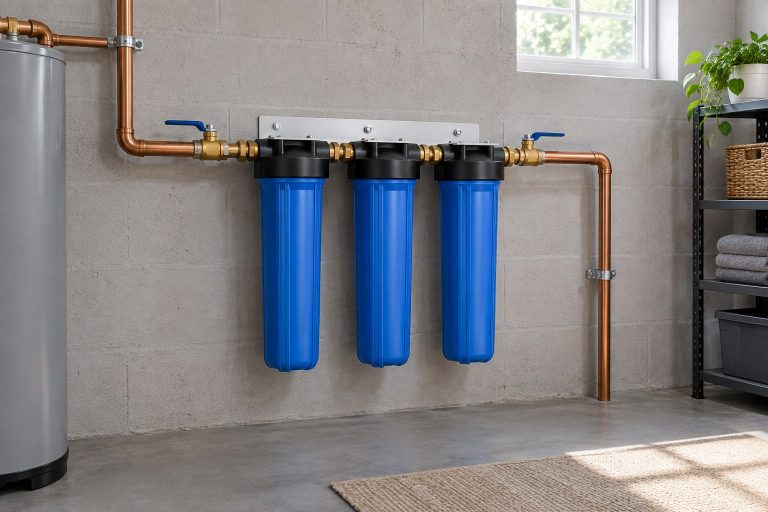
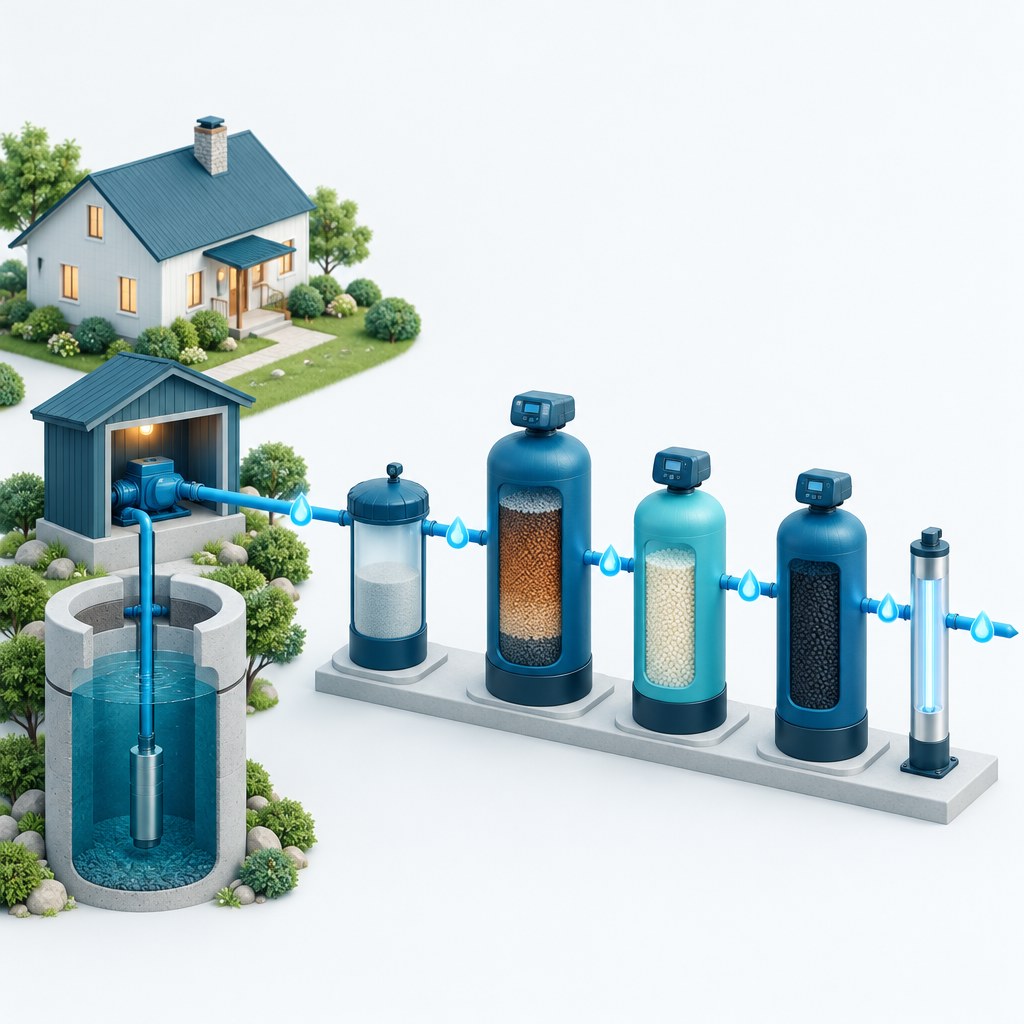
A water filtration system for well water is a sequenced treatment train, not a single filter. Test first, then install sediment removal, iron and sulfur treatment, softening, and carbon in that order, with NSF/ANSI 55 Class A UV last, sized to your well’s GPM yield.
- Test before you shop. A certified lab panel beats stains, smells, and sales quotes.
- Sequence decides success. UV installed ahead of iron or turbidity removal fouls its sleeve and fails.
- Size for the well, not just the house. Backwash demand of 10 to 15 GPM can drain a low-yield well.
- Read the UV label. Class A delivers 40 mJ/cm²; Class B does not disinfect.
- Retest after install. A second lab result is the only proof the train works.
Test First: What the Lab Report Has to Show
Rust-colored stains, a rotten-egg smell, and white crust on fixtures each point to a different fix. Guessing from symptoms wastes thousands of dollars.
Use a state-certified lab, sterile bottles, and a completed chain of custody (CoC) form. Match the sample ID and collection time to the bottle exactly. Coliform samples usually need to reach the lab within about 30 hours. A simple screen from water test kits is fine for tracking hardness or pH between lab visits, but a certified water testing panel is what your equipment should be sized against.
Here’s what each result means and where the thresholds sit. Primary standards protect health. Secondary standards cover taste, odor, and staining.
| Parameter | Threshold | Type | What it tells you |
|---|---|---|---|
| Total coliform / E. coli | Zero detectable is the target | Primary | Any positive means a contamination pathway |
| Nitrate (as N) | 10 mg/L | Primary | Infant risk; needs RO or ion exchange, not UV |
| Nitrite (as N) | 1 mg/L | Primary | Same source as nitrate |
| Arsenic | 0.010 mg/L | Primary | Needs RO or specialty media |
| Iron | 0.3 mg/L | Secondary | Stains; fouls resin and UV sleeves |
| Manganese | 0.05 mg/L | Secondary | Black staining; fouls UV sleeves |
| pH | 6.5 to 8.5 | Secondary | Low pH corrodes plumbing and limits some media |
| Total dissolved solids | 500 mg/L | Secondary | Taste and scale |
| Sulfate / chloride | 250 mg/L each | Secondary | Taste; sulfate feeds sulfur bacteria |
| Hydrogen sulfide | No federal limit | Odor | Rotten-egg smell; corrodes plumbing |
| Turbidity | Under 1 NTU for UV | Equipment | Cloudiness shields microbes from UV light |
The EPA lists the secondary limits on its secondary drinking water standards page.
Hardness gets its own scale. The USGS classifies hardness as soft at 0 to 60 mg/L, moderately hard at 61 to 120, hard at 121 to 180, and very hard above 180. One grain per gallon (gpg) equals 17.1 mg/L, so 7 gpg is about 120 mg/L.
Two Field Checks Before the Lab Report Arrives
Unscrew a kitchen aerator and look at the screen. Black grit points to manganese. A slick pink or orange film points to bacterial slime, not just mineral scale.
Fill a clear glass and let it stand for ten minutes. Water that runs clear, then turns orange, carries dissolved ferrous iron. Water that arrives already rust-colored carries oxidized ferric iron.
These checks narrow the options. They don’t replace a lab result.
The Treatment Train: Why Order Decides Whether Anything Works
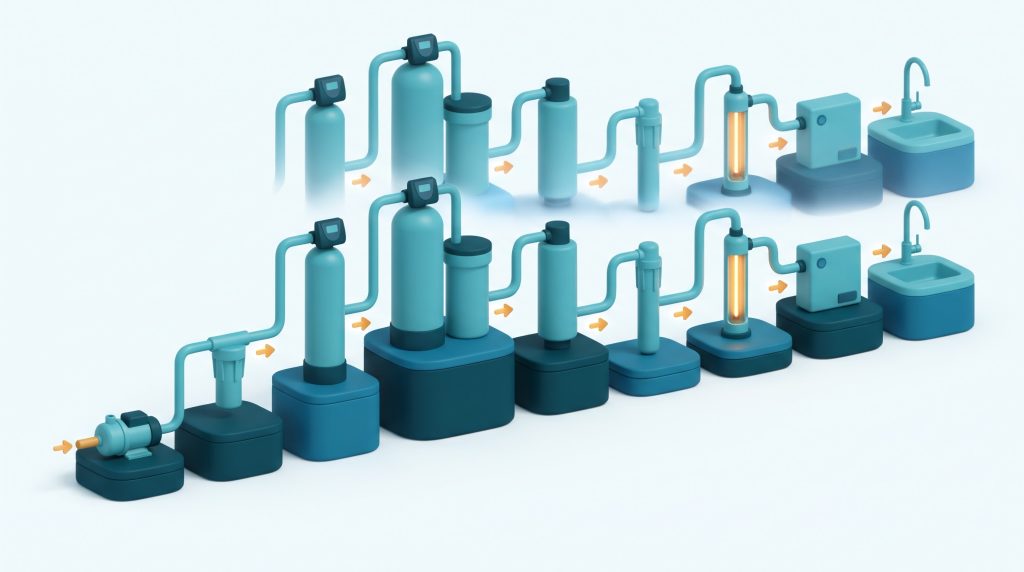
Every stage has an input limit. Put a stage ahead of the one that protects it, and it clogs, scales, or stops disinfecting.
| Stage | Job | Why it sits here |
|---|---|---|
| 1. Sediment pre-filter (spin-down or 20 to 50 micron) | Sand, silt, rust particles | Protects every later stage from clogging |
| 2. Oxidation and iron, manganese, sulfur removal | Converts dissolved metals and gas to filterable form | Must happen before softening and UV |
| 3. Water softener (ion exchange) | Removes calcium and magnesium | Scale protects nothing and coats UV sleeves |
| 4. Catalytic carbon or KDF-55 | Chlorine, chloramine, sulfur polish, taste | Removes oxidant before RO and protects resin |
| 5. Polish filter (1 to 5 micron) | Last particle barrier before UV | Keeps turbidity under 1 NTU |
| 6. UV, NSF/ANSI 55 Class A | Inactivates bacteria, viruses, protozoa | Needs clear, soft, iron-free water |
| 7. Point-of-use RO (NSF/ANSI 58) at one tap | Arsenic, nitrate, dissolved solids | Treats drinking water only |
That’s the sequencing rule most competitor guides skip. Point-of-entry (POE) equipment treats the whole house. Point-of-use (POU) equipment treats one tap.
Why UV Goes Last
UV lamps kill microbes with light, and light only works through a clean quartz sleeve in clear water. Iron stains the sleeve. Manganese coats it. Hardness above about 7 gpg bakes scale onto it.
Once the sleeve fouls, the dose drops below the disinfection target and nobody notices. The water still looks fine. Bacteria pass through.
Most UV makers publish input limits close to these: iron at or below 0.3 mg/L, manganese at or below 0.05 mg/L, hardness at or below 7 gpg, turbidity at or below 1 NTU, and ultraviolet transmittance of at least 75 percent. Check the exact numbers on the model you buy.
NSF/ANSI 55 Class A vs. Class B
| Class A | Class B | |
|---|---|---|
| Minimum UV dose | 40 mJ/cm² | 16 mJ/cm² |
| Purpose | Inactivates pathogens, including bacteria, viruses, and protozoa | Supplemental reduction of nuisance bacteria |
| Use on raw well water? | Yes, with proper pre-treatment | No |
Class B units are meant for water that’s already microbiologically safe. Don’t buy one for a well with a coliform history.
Iron, Manganese, and Hydrogen Sulfide Options
Three approaches dominate backwashing iron filters:
- Air injection oxidation (AIO). Air collects in the tank head and oxidizes iron, manganese, and sulfur without chemicals.
- Catalytic media. Birm-type media needs pH above roughly 6.8 and dissolved oxygen. Other catalytic media tolerate a wider pH range and handle manganese better.
- Chlorine injection with contact tank. The strongest option for heavy sulfur and iron bacteria. Follow it with catalytic carbon to remove the leftover chlorine.
If pH sits below 6.5, add a calcite neutralizer first. Acidic water corrodes copper and starves some media.
Softening and Ion Exchange
A softener swaps calcium and magnesium for sodium on a resin bed. Standard resin has about 8 percent cross-linking; 10 percent resists oxidants better when chlorine is present.
Iron is the resin’s enemy. Even low single-digit iron levels coat the beads and cut capacity, so remove iron upstream. Chemistry also adds sodium: roughly 8 mg/L per gpg of hardness removed. A 15 gpg well produces about 120 mg/L sodium in the softened water. That’s relevant to anyone on a low-sodium diet.
Catalytic Carbon and KDF-55
Chloramine passes straight through ordinary carbon at normal contact times. Catalytic carbon is engineered to break it down, and it also polishes residual hydrogen sulfide. KDF-55, a copper-zinc alloy, reduces free chlorine and helps suppress bacterial growth inside carbon beds.
Both need sediment protection and scheduled replacement. Neglected carbon becomes a bacteria bed.
Size It: GPM, Backwash Demand, and Your Well’s Recovery Rate
Undersized trains choke the shower. Oversized backwash drains the well.
Peak Demand
Start with the household. A 1 to 2 bathroom home typically needs 7 to 10 GPM at peak. A home with 3 or more bathrooms needs 12 to 15 GPM or more. Add the fixtures that could run together: two showers, a dishwasher, and a washing machine.
Backwash Demand
Backwashing iron filters require a minimum upflow to lift and clean the media bed. Flow equals bed area times the media maker’s backwash rate, commonly 10 to 15 GPM per square foot.
| Tank diameter | Bed area | Backwash flow at 10 to 15 GPM per ft² | Water used in a 10-minute cycle |
|---|---|---|---|
| 10 inches | 0.55 ft² | 5.5 to 8.2 GPM | 55 to 82 gallons |
| 12 inches | 0.79 ft² | 7.9 to 11.8 GPM | 79 to 118 gallons |
| 13 inches | 0.92 ft² | 9.2 to 13.8 GPM | 92 to 138 gallons |
| 14 inches | 1.07 ft² | 10.7 to 16.0 GPM | 107 to 160 gallons |
Now compare that to the well. Your driller’s log lists the well’s yield in GPM. A well that recovers 3 GPM can’t feed a 12 GPM backwash for 10 minutes. The pump runs the well down, sucks air, and burns out.
Fixes that work:
- Add a break tank. A storage tank fills slowly from the well, then supplies the backwash.
- Match tank size to yield. A smaller bed backwashes at a lower GPM.
- Schedule backwash overnight with low household demand.
- Don’t throttle the drain flow control below the media maker’s minimum. An under-flushed bed channels and fouls.
- Plan the drain. A 100-gallon dump every few days can overload a small septic field.
The Pressure Budget
Most wells run a 40/60 PSI pressure switch. Treatment equipment typically wants at least 20 to 30 PSI at the inlet, and each stage subtracts some. A clean 20-inch cartridge housing commonly drops 1 to 3 PSI at household flow, but check each manufacturer’s pressure-drop curve.
Install gauges before and after the first housing. Replace cartridges when the differential climbs to roughly 10 PSI. If the first reading is 55 and the second is 44, the cartridge is done.
Rules by Region: U.S. and U.K.
United States. The Safe Drinking Water Act regulates public water systems. Private wells are exempt, so no agency checks your water. Your state or county health department may offer testing guidance. Follow the EPA private well resources.
England. The Private Water Supplies (England) Regulations 2016 split supplies by type. Regulation 9 covers large supplies using 10 cubic meters or more per day, or supplies used commercially or publicly. Regulation 10 covers other supplies, mainly shared domestic ones. Local authorities monitor regulation 10 supplies for conductivity, enterococci, E. coli, pH, and turbidity at least every five years.
A single dwelling isn’t monitored unless the owner requests it. The Drinking Water Inspectorate explains the categories on its types of private supplies page. The regulations set manganese at 50 µg/L and sodium at 200 mg/L, which matters if you soften.
Scotland, Wales, and Northern Ireland have separate regulations. For Canada and Australia, check your provincial or state health authority, because testing duties and treatment standards differ.
Post-Install Troubleshooting Workflow
Run this sequence after install and any time something changes:
- Retest. Send a certified sample two to four weeks after commissioning. Coliform must read absent.
- Read the gauges. Record inlet and outlet PSI monthly.
- Inspect the UV sleeve. Clean it per the maker’s schedule and replace the lamp yearly.
- Check the softener salt and iron. Resin cleaner if iron slips through.
- Retest after floods, repairs, or taste changes.
| Symptom | Likely cause | Fix |
|---|---|---|
| Rotten-egg smell returns | Sulfur load exceeds media capacity | Add chlorine injection or catalytic carbon polish |
| Pressure drops at the shower | Loaded cartridge or undersized housing | Replace cartridge; check GPM rating |
| Orange staining returns | Iron filter exhausted or backwash too short | Extend cycle; check media and air charge |
| Coliform positive after UV | Fouled sleeve or bypass | Clean sleeve; verify sequence and pre-filters |
| Well runs dry during backwash | Backwash GPM exceeds yield | Add break tank; resize bed |
For a broader look at the whole-home options, our whole house water filters section compares systems. For stains, odor, and scale diagnoses, see common well water problems.
Planning Budget
These U.S. ranges are planning estimates only, not quotes, and installed prices vary by region and plumbing.
| Stage | Typical installed range |
|---|---|
| Sediment pre-filter | $150 to $500 |
| Iron, manganese, sulfur filter | $1,200 to $3,500 |
| Water softener | $1,000 to $3,000 |
| Catalytic carbon tank | $800 to $2,500 |
| UV disinfection | $600 to $1,800 |
| POU reverse osmosis | $300 to $1,000 |
Skip stages the lab report doesn’t justify. A well with iron but no bacteria doesn’t need UV. A well with coliform but clear water may need only UV and a pre-filter.
Frequently Asked Questions
What is the best water filtration system for well water?
The one matched to your lab report. Most wells need a sediment pre-filter, iron or sulfur treatment, often a softener, and UV for bacteria, in that order.
Can I install UV before the iron filter?
No. Iron, manganese, and hardness foul the quartz sleeve and drop the UV dose below the disinfection target. Install UV last, after pre-treatment and a polish filter.
How much GPM does my well need for a backwashing filter?
At least the filter’s backwash rate, often 8 to 15 GPM for a household-size tank. If the well yields less, add a break tank or resize the bed.
Does a water softener remove iron?
Only small amounts of clear-water iron, and it can foul the resin. Remove iron upstream with an iron filter, then soften.
Is NSF/ANSI 55 Class B UV enough for a private well?
No. Class B delivers 16 mJ/cm² for supplemental nuisance bacteria reduction. Well water with coliform risk needs Class A at 40 mJ/cm².
Order the Water Analysis Before the Equipment
A $3,000 system installed against the wrong problem is a $3,000 mistake. The right order starts with a number from a certified lab.
Schedule a certified private-well panel this week. Ask for coliform, nitrate, arsenic, iron, manganese, hardness, pH, and turbidity, plus hydrogen sulfide if you smell sulfur. Browse our water testing guides to prepare the sample, then match each flagged result to the stage in the table above before anyone quotes you hardware.
This article is general education and doesn’t replace advice from your local health department or a licensed water treatment professional. Standards and regulations change, so confirm current limits with the EPA, your state, or your national regulator.