

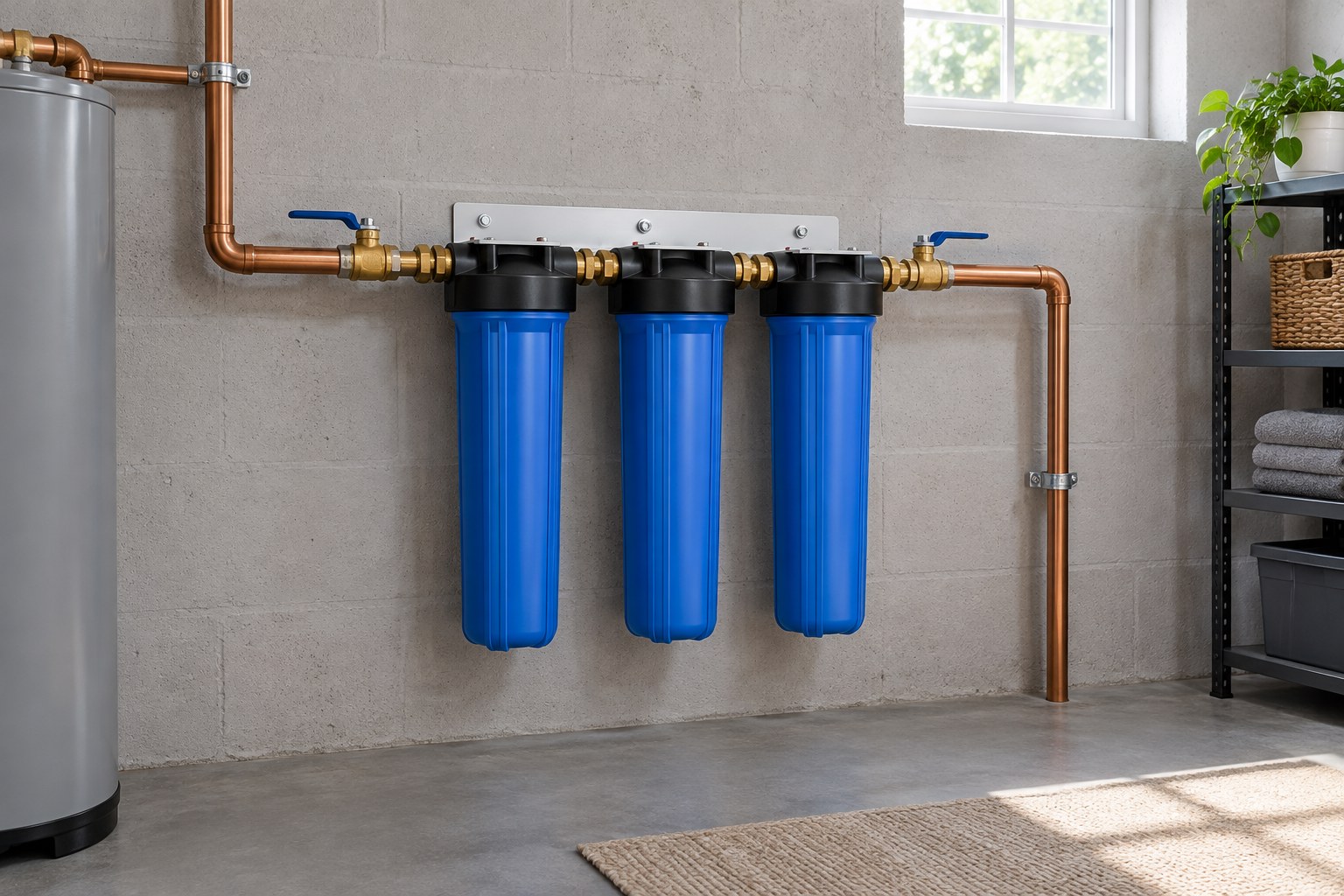
Chlorinated water, orange staining and scale build up on water heater. Most people begin to look into purchasing a water filtration system. However, they are often put off by the price and are worried about purchasing the wrong system and having low water pressure in their shower.
A whole house water filtration system is a point of entry system that is fitted to your main water line. The system will filter all water coming out of taps, showers and appliances. These will usually include sediment removal with catalytic or KDF carbon media. Some will also include UV or iron removal, depending on the source of your water.
Budget roughly $450 to $1,500+ for hardware. A plumber usually adds somewhere between $300 and $900 for installation, depending on how much piping has to change. One fact belongs up front because it drives a lot of returns: carbon, KDF, and sediment filters do not soften hard water. iSpring says its WGB32B does not reduce hardness, and the brand’s own listings note that these systems do not reduce TDS. Hardness needs a softener or a scale-control device. More on that below.
What a whole house filter handles, and what it doesn’t:
- Reduces: chlorine, chloramine (with the right media), sediment, rust, taste and odor, some VOCs and heavy metals, depending on media.
- Does not reduce: calcium and magnesium hardness, total dissolved solids, nitrate, or fluoride.
- Flow limit: match it to your peak GPM and your main line size, not to the biggest number on the box.
- Maintenance: cartridges run on 3 to 12 month cycles; media tanks can run up to 10 years.
- Order of operations: test your water first, then pick the media.
Quick Picks: Whole House Systems Matched to US Water Chemistry
Prices move daily on Amazon, so use the figures below as a yardstick, not a quote. Every flow number is a manufacturer ceiling, not a guaranteed service rate.
| Pick | Best for | Port size | Claimed max flow | Core treatment | Yearly replacement cost |
|---|---|---|---|---|---|
| iSpring WGB32B-KSNC | City water with chloramine | 1″ NPT, 20″ x 4.5″ cartridges | Up to 15 GPM | SGS-tested at 94.4% chloramine reduction | About $340 for the full replacement pack |
| iSpring WGB32BM | Well water with iron and manganese | 1″ fittings | 15 GPM | Takes iron from 3.0 ppm and manganese from 1.0 ppm down to 0.01 ppm | FM25B cartridge about $109; plan $180 to $200 with sediment and carbon |
| Aquasana Rhino EQ-1000 | Low-maintenance city water | Kit fittings; confirm on listing | 7 GPM rated; 14.6 GPM on one retail listing | Carbon and KDF tank, 1,000,000 gallons | About $125 in pre- and post-filters |
| Express Water WH300SCKS | Heavy metals on a budget | 1″ standard connections | 15 to 17 GPM class on sister models | Sediment, KDF, carbon block; gauges included | $170 to $340 |
| HQUA-OWS-12 UV | Disinfecting clear, pre-treated well water | 3/4″ MNPT | 12 GPM | UV lamp, no chemicals | Lamp every 365 days; one spare bulb included |
| Waterdrop BG103 | Sand and silt pre-filter | Confirm on listing | 25 GPM | 500 + 200 micron dual mesh, reusable | $0 in cartridges; rinse every two weeks |
Two things to keep in mind. The Aquasana has a large gap between their stated flow rate. The Rhino 1,000,000 gallon is rated at 7 GPM by its manufacture. However, the retail site states that it offers 14.6 GPM. Choose the unit based on the rated flow rate. The standard Rhino is only tested for chlorine removal. If your water utility uses chloramine, make sure you have the correct chloramine setup.
Step 1: Run a US Water Chemistry Check Before You Buy Anything
Wrong filter media is the most expensive mistake in this category. Fifteen minutes of homework prevents it.
Read Your Consumer Confidence Report
Utilities must send a Consumer Confidence Report (CCR) by July 1 each year. If yours is buried on the utility’s site, EPA’s CCR search tool will locate it. Scan for four things:
- Disinfectant type. “Chlorine” and “chloramine” (or “monochloramine”) call for different media.
- Disinfection byproducts. TTHM and HAA5 readings tell you how much organic carbon load your carbon stage will face.
- PFAS results. Monitoring is ramping up (details below).
- Source. Surface water means more chlorine pressure and seasonal turbidity swings. Groundwater means more hardness and minerals.
CCRs often skip hardness. Ask the utility, then compare against USGS classes: under 60 mg/L is soft, 61 to 120 moderately hard, 121 to 180 hard, and above 180 very hard. One grain per gallon equals about 17.1 mg/L. The EWG Tap Water Database adds ZIP-code context. Read it as a prompt for questions, since it flags contaminants against health guidelines that are stricter than legal limits.
The Chloramine Trap
Chloramine is a complex bond between chlorine and ammonia. It is a very persistent chemical. Plain granular activated carbon (GAC) can easily remove free chlorine, but chloramine passes through. The EPA estimated that around 30% of surface water utilities would use chloramine as a secondary disinfectant, however industry estimates are now higher at 35-40% of municipal water being treated with chloramine. Large systems using chloramine include Los Angeles, San Francisco, Washington DC and Houston.
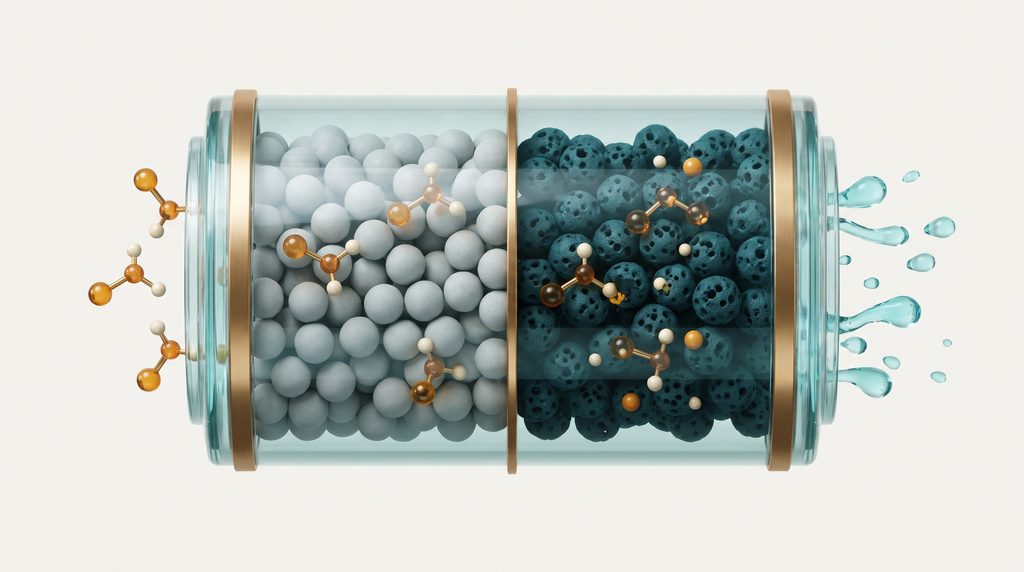
The solution is to use catalytic carbon. Often combined with KDF-55 to help remove chlorine and metals. The contact time is also important. This is why iSpring have a specific catalytic carbon cartridge for chloramine removal (FC25B-NC). Chloramine grade media is also more expensive to replace, this is reflected in the cost table below.
PFAS: Where the Rules Stand
The 2024 EPA rule requires PFOA and PFOS to be below 4.0 parts per trillion. Monitoring is to begin by April 26th 2027. Compliance is by April 26th 2029. The EPA has proposed to allow systems requesting more time to comply until April 26th 2031. Neither of the 2026 proposals have been finalised yet (early October 2026). This means that your utility may not have any numbers on PFAS in your tap water for another year or so. If this is a concern then get them tested.
Baseline Testing for Private Wells
Wells have no CCR. You are the utility. EPA’s private well guidance recommends at least annual checks for total coliform, nitrate, pH, and TDS. Add the rest if you plan to treat.
| Parameter | Federal benchmark | Why it matters for filter choice |
|---|---|---|
| Total coliform / E. coli | Absent | Positive result means UV or other disinfection |
| Nitrate | 10 mg/L as N (MCL) | Carbon will not remove it; RO or ion exchange will |
| Iron | 0.3 mg/L (secondary standard) | Stains; fouls UV sleeves and softener resin |
| Manganese | 0.05 mg/L (secondary) | Black staining; UV pre-treatment limit |
| Arsenic | 10 µg/L (MCL) | Needs targeted media, not standard carbon |
| pH | 6.5 to 8.5 (secondary) | Acidic water corrodes pipes and shifts media performance |
| TDS | 500 mg/L (secondary) | Filters do not reduce it |
| Hardness | USGS classes above | Decides softener vs. conditioner |
| Turbidity | Under 1 NTU for UV | Cloudy water shields microbes from UV light |
Buying a house on a well in a tight timeline? Rhode Island buyers should work through the 10-day well water testing checklist for home sales. Everyone else closing on a rural property should read the complete guide to well water testing for home buyers before the inspection window ends.
Step 2: The GPM and Pipe Sizing Formula That Protects Your Shower
Low pressure is the number-one complaint in filter reviews, and the cause is almost never the filter alone. It is a rated flow that doesn’t match the household, a trunk line that can’t carry the water, or both.
Size to Peak Demand
You could add up the flow rates. For example, during a typical peak period in the morning you might have two showers running (2.0-2.5 GPM each), a washing machine (2-3 GPM), a kitchen sink (1.5 GPM) and a toilet refilling (1-1.5 GPM). This would total around 10-11 GPM in a three bathroom property.
| Home size | Peak demand to plan for |
|---|---|
| 1 to 2 bathrooms | 7 to 10 GPM |
| 3 to 4 bathrooms | 12 to 15 GPM |
| 5+ bathrooms | 15 to 20 GPM |
Pick a system whose rated service flow clears your number with room to spare. If you only see “max flow,” assume real service flow runs lower, as the Aquasana example showed.
Match the Housing to the Pipe
The 20″ x 4.5″ Big Blue housing with 1″ ports can only be as best as the pipe feeding into it. Using the numbers below, with nominal internal diameters (flow = velocity x area), plumbers will usually aim for a velocity of around 5ft/s for cold water to keep things quiet. The maximum velocity is 8ft/s.
| Main trunk line | GPM at 5 ft/s | GPM at 8 ft/s |
|---|---|---|
| 3/4″ PEX | ~5.5 | ~8.8 |
| 3/4″ copper (Type L) | ~7.5 | ~12.1 |
| 1″ PEX | ~9.1 | ~14.6 |
| 1″ copper (Type L) | ~12.9 | ~20.6 |
Do the math. A 15 GPM filter will still only be a 9 GPM system. Each of the ports will have a reducer fitting attached to them. If your flow rate is above the 8 ft/s column then you will need to use 1″ lines through the filter section or upgrade your trunk.
Catch Pressure Loss Early
A clean 1″ system should be a few PSI. The 10-15 PSI drop is because of either loaded cartridges, undersized piping or both. A good idea is to fit pressure gauges on both sides of the housings. Express Water send their system with pressure gauges fitted. If the pressure differential increases beyond about 10 PSI you should replace the cartridges. You should also check what pressure the unit is rated to run at. iSpring WGB32BM is rated between 25-80 PSI whilst the Rhino from Aquasana is rated to a max of 100 PSI.
Hardware Showdown: Cartridge Systems vs. Media Tanks
| Factor | 3-stage 20″ cartridge system | 1,000,000-gallon upflow media tank |
|---|---|---|
| Upfront cost | About $420 to $550 | About $1,100 to $1,400 |
| Replacement cycle | Every 6 to 12 months | Up to 10 years for the tank |
| Yearly consumables | $115 to $340 | About $125 in pre/post filters |
| Rated flow | Often 15 GPM class | 7 GPM rated |
| Swap labor | 15 to 30 minutes per housing, with pressure relief and O-ring care | Quick tank swap; pre-filter every 2 months |
| Lock-in | Standard 20″ x 4.5″ sizes; third-party cartridges fit | Aquasana says using other manufacturers’ parts voids the warranty |
| Replacement tank | Not applicable | Listed at $1,299 in July 2026 for the Max Flow tank |
Cartridge systems win on upfront price and flow. Tanks win on time. The hidden cost on tanks is proprietary parts, and the hidden cost on cartridges is you, on a ladder with a housing wrench twice a year.
Well Water Adds Pre-Treatment Rules
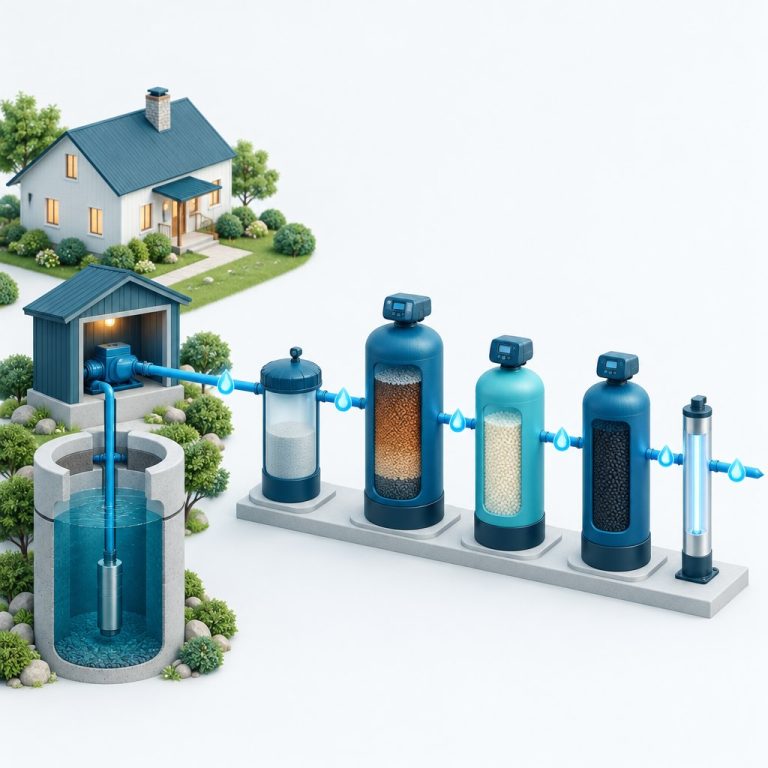
Shortcuts are punished by wells. Cartridges will deal with light iron. The iSpring FM25B Iron Cartridge can handle approx 50,000 gallons of 3.0ppm iron, or approx 12 months of 200 gal per day. If you have heavy iron, Iron Bacteria or Hydrogen Sulfide then you would need an oxidising media tank.
UV is the final disinfection step and the fussiest. Pre-treat to these limits before it goes in:
- Iron: under 0.3 ppm
- Manganese: under 0.05 ppm
- Turbidity: under 1 NTU
- Hardness: typically under about 7 grains per gallon, per most UV manufacturers’ guidance
Standard UV lamps are specified to emit 254nm light and be used with a dose of 40mJ/cm². However, if the quartz sleeve becomes encrusted then the dose will drop. UV bulbs also lose 30-40% of germicidal effect by 12 months so it is important to replace on time even if the lamp is still giving off light. The manufacturers manual clearly states that correct pre-treatment is important.
Plumbing Order, Softeners, and 5-Year Total Cost of Ownership
The Correct Sequence
Main Shut-Off → Spin-Down Sediment Filter → Whole-House Filter → Softener → UV → HomePlace the sediment filter first to avoid the carbon becoming blinded by rust and grit. The carbon filter should be placed before the softener as chlorine will damage the ion exchange resin. Finally place the UV filter.
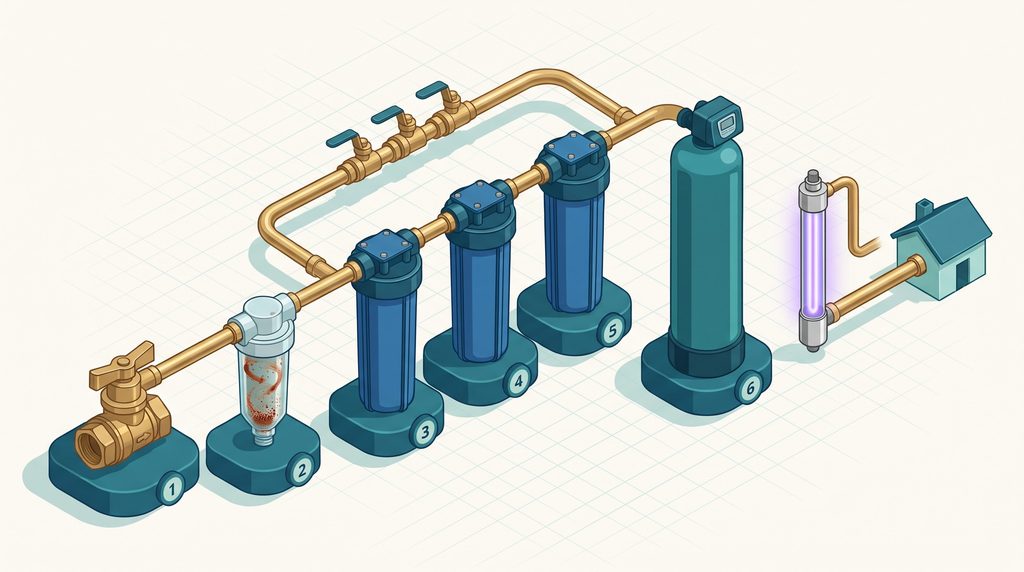
The filter section should be fitted with a 3 way brass bypass valve. This means you can close the inlet and outlet valves and open the bypass allowing you to service or remove the system. If possible fit an isolation valve on each housing.
Freeze and environment rules:
- Keep the system inside the conditioned envelope where winters hit freezing. Ice cracks housings.
- Aquasana lists a 40 to 90°F operating range, and many cartridge systems top out near 100°F, so avoid hot attics and equipment rooms.
- If the main sits in a garage, use an insulated, heated enclosure, or move the filter inside.
- With copper mains, a ground jumper bridges the plastic housings. iSpring’s manual includes a ground jumper cable for this reason.
- Check your municipality’s permit rules before cutting into the main.
Softener vs. Filter: What Each Actually Does
A filter removes contaminants. A salt-based softener swaps calcium and magnesium for sodium through ion exchange, adding about 8 mg/L of sodium per grain of hardness removed. A template-assisted crystallization (TAC) salt-free conditioner doesn’t remove hardness at all. It changes how scale forms so it clings less. Sizing, costs, and legal limits on brine discharge are covered in this whole-home softener sizing and installation guide.
Carbon-filtered water is also not mineral-free. If you run a humidifier, you still need to deal with minerals, so see distilled water for humidifiers.
Five-Year Cost of Ownership
Assumptions used are 2026 list price for hardware, first filter pack included in box, 4 filter changes over 5 years. Plumber installation cost of $600 (halfway between $300-$900). For softener pipework, we have used planning assumptions (price per unit, approx 10-14 40lb bags of salt per year, no resin changes over 5 years). You will need to obtain local quotes.
| System | Hardware | 4 years of replacements | Install | 5-year total |
|---|---|---|---|---|
| iSpring WGB32B (chlorine-only city water) | $420 | 4 × $114.99 ≈ $460 | $600 | ≈ $1,480 |
| iSpring WGB32B-KSNC (chloramine) | ≈ $640 | 4 × $339.99 ≈ $1,360 | $600 | ≈ $2,600 |
| Aquasana Rhino (chloramine config) | $1,399 | Pre/post bundles every 6 months at about $62 ≈ $560 | $600 | ≈ $2,560 |
| Express Water WH300SCKS | $548 | $170 to $340 a year, midpoint ≈ $1,020 | $600 | ≈ $2,170 |
| Salt-based softener (planning figure) | ≈ $900 | Salt ≈ $450 | $600 | ≈ $1,950 |
| TAC salt-free conditioner (planning figure) | ≈ $900 | Media ≈ $150 | $600 | ≈ $1,650 (does not soften) |
The takeaway: chloramine-grade media erases the price advantage of a cheap cartridge system. Run the math on your own supply before assuming budget hardware is the budget answer. And keep a fallback for the days the main is isolated for service. A portable option like the one in this Sawyer Squeeze water filter review won’t replace a whole house system, but it keeps you drinking safe water while the system is out of service.
Logistics and Governance: State-Certified Labs and Chain of Custody
Testing is where buying decisions get made or ruined. Do it right.
Choose a State-Certified Laboratory
Your state drinking water program certifies labs for specific analytes and methods. Certification for one test does not cover another. Before paying, ask for:
- The lab’s current state certificate and certificate number.
- Proof the scope covers the exact parameters you are ordering (total coliform, nitrate, metals, PFAS).
- Reporting limits low enough to compare against the standards in the table above. For PFAS, the limit needs to sit well under 4 ppt.
A home test strip kit won’t cut it for a purchase decision, a real estate negotiation, or a UV sizing call.
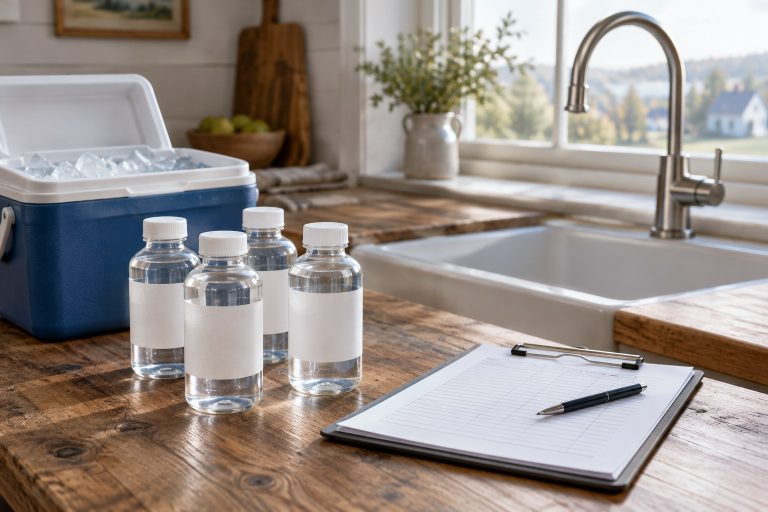
Sampling Basics
- Use the lab’s bottles. Don’t rinse bottles that arrive pre-preserved.
- For bacteria, remove the aerator, run cold water for several minutes, and keep fingers off the bottle mouth and cap.
- Chill samples and get them to the lab promptly. Most labs want bacteria samples received within about 24 to 30 hours, so don’t collect on a Friday afternoon.
- Sample at the point you are evaluating: the kitchen tap for drinking water, a hose bib before the treatment for raw water.
Document the Chain of Custody (CoC)
A chain of custody form records who collected, handled, and received the samples. It protects you if the results are disputed, and it is standard for real estate transactions and any legal or regulatory use. Fill out:
- Collector’s name, date, and time of collection.
- Sample ID, sample location, and tap or source description.
- Preservative added (if any) and the container type.
- Signatures, with date and time, at every handoff: you to courier, courier to lab, lab check-in.
- Condition on receipt, including temperature.
Photograph the labeled bottles at the tap before shipping. For a step-by-step walkthrough of sampling and reading results, see how to test well water.
NSF Verification: Decode the Standards, Spot the Loophole
What Each Standard Covers
| Standard | What it verifies |
|---|---|
| NSF/ANSI 42 | Aesthetic effects: chlorine, taste, odor |
| NSF/ANSI 53 | Health-related contaminants such as lead; PFAS claims sit under 53 and 58, not 401 |
| NSF/ANSI 55 | UV disinfection systems; Class A requires a 40 mJ dose |
| NSF/ANSI 401 | Emerging contaminants such as pharmaceuticals |
| NSF/ANSI 44 / 58 | Softeners / reverse osmosis |
| NSF/ANSI 372 | Lead-free materials in the product, not lead reduction performance |
Read the fine print. A product can be certified to NSF/ANSI 42 for chlorine only, which says nothing about the other 42 claims.
The “Tested to NSF Standards” Loophole
Two phrases look identical on a box and mean very different things:
- “Certified to NSF/ANSI” (by NSF, WQA, or IAPMO): NSF is one of several organizations that can certify to these standards, and WQA and IAPMO also do so. The product appears in a public database.
- “Tested to NSF standards”: Any manufacturer can make this claim, with no audit or certification number required.
In real life, Aquasana state their Rhino has been independently tested to 97% chlorine reduction under NSF/ANSI 42. However, the independant certification tracking site mentions that this is data from tests done by the brand. The tank itself is certified to meet material safety standards under NSF/ANSI/CAN 61. iSpring’s KSNC uses SGS data to show it CAN remove 94.4% of chloramine. Whilst SGS is a valid lab, this is lab data not certification. The WGB32B has been described as certified to meet NSF/ANSI 42 and 53 standards in at least one review. It is best to check by model number.
Verify in three steps:
- Search the exact model number in the NSF Certified Drinking Water Treatment Units database or the WQA Gold Seal listings.
- Match the contaminant claim you need (chloramine, lead, PFOA/PFOS) to a listed row, not just a standard number.
- Compare the tested flow rate and capacity to your actual household demand.
Frequently Asked Questions
Does a whole house water filter remove PFAS?
Only if it carries a specific PFAS claim, ideally NSF/ANSI 53 for PFOA and PFOS. Plain carbon blocks reduce some PFAS, but for drinking water at the tap, add a certified under-sink reverse osmosis system as the final barrier.
Can I install a whole house water filter in a garage?
Yes, if the garage never freezes. Ice cracks housings, and listed operating ranges run roughly 40 to 100°F. In cold climates, use a heated, insulated enclosure or mount the system inside the conditioned space near the main shut-off.
Does a whole house filter reduce water pressure?
Every filter adds some loss. A correctly sized 1-inch system with clean 20-inch cartridges usually costs 2 to 5 PSI. Drops of 10 to 15 PSI signal clogged media, an undersized 3/4-inch line, or a unit rated below your peak GPM.
Should I pair a whole house filter with under-sink RO?
Yes, for most homes. The whole house unit removes chlorine and sediment at every tap and protects the RO membrane, while the RO polishes drinking water for dissolved solids, nitrate, and PFAS. Chloramine-grade carbon upstream also extends membrane life, which saves replacement costs.
Do I still need a softener?
Yes, if your water tests hard (over 120 mg/L, or about 7 grains per gallon). Filters don’t remove calcium or magnesium.
How often should I change cartridges?
Follow the pressure gauge first and the calendar second. Plan on 6 to 12 months for most 20″ sets, and every 2 months for tank-system pre-filters.
Test First, Then Treat: Your Next Move
This is the water your family uses daily to drink, shower, and cook. By just guessing the media in your filters you are risking contaminating your water with an untested contaminant. Plus you are wasting hundreds of dollars on the wrong cartridges. Chloramine will pass through your standard carbon filters. Iron will destroy your UV lamps. And hard water will destroy your water heater no matter what filter you choose.
This week do three things. If you are on city water then pull your CCR or schedule a state certified lab panel with a signed chain of custody if you have a well. Sizing your system for your highest GPM and trunk line. Only purchase what you need based on your results. Check the NSF/WQA listing for your model number.
Schedule a certified water analysis or order a lab test kit today. Start with the step-by-step well testing guide, then match your results to the right system above.




[…] could run at once, then pick a system rated at or above that flow at your actual line pressure. Our whole-house water filtration buyer’s guide walks through sizing and installation in […]
[…] water filtration system for well water is a sequenced treatment train, not a single filter. Test first, then install […]