


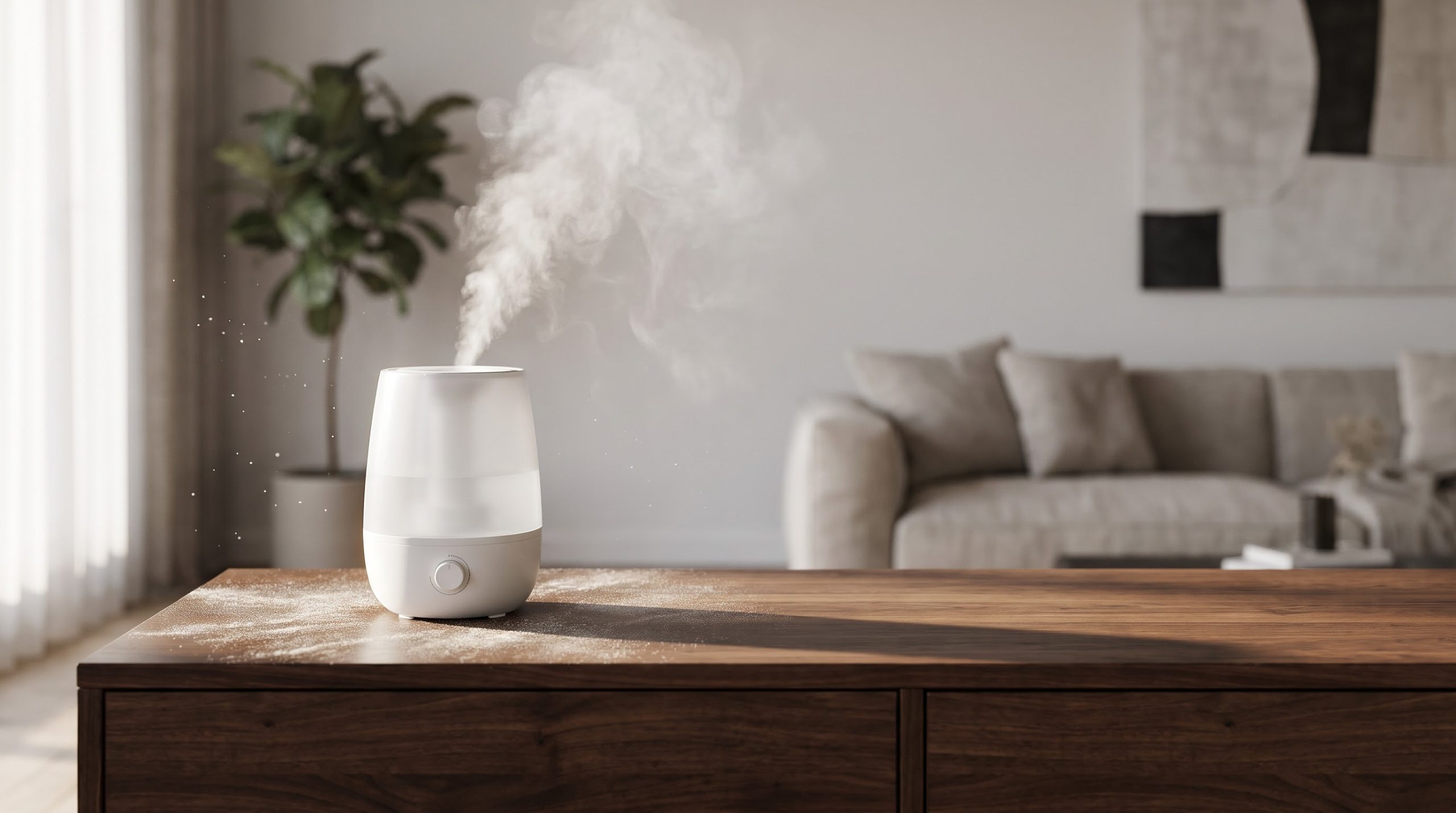
If you are experiencing white dust on your furniture; or scaling on the inside of your humidifier and constantly having to clean out the tank then the issue could be down to the water you are using. Distilled water is best used with most types of humidifier, especially ultrasonic and impeller humidifiers as it contains little to no dissolved minerals.
Using distilled water will help prevent white dust, slow scaling and help you carry out regular maintenance. Ultrasonic and impeller humidifiers can quickly spread minerals from tap water into the air, so using water with low levels of dissolved minerals is recommended to reduce scaling and the release of minerals (EPA).
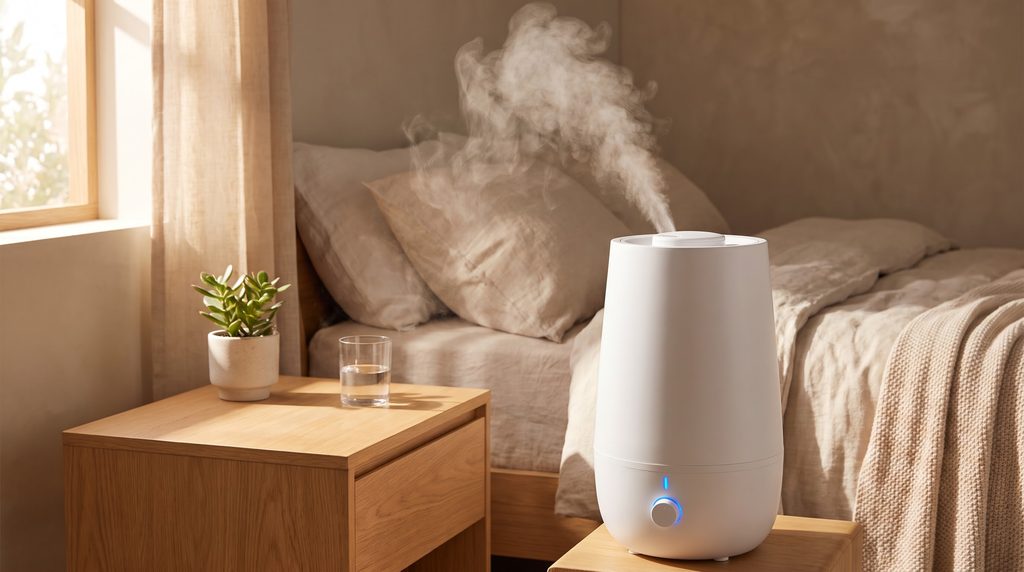
However, you may not need to use distilled water. It depends on the type of humidifier you have, the hardness of the water where you live and how regularly you are happy to clean your humidifier. Evaporative and steam vapourisers will commonly remove or boil off most minerals so you may be able to use tap water. However, some will still cause build-up.
This guide will explain exactly when you should be using distilled water in your humidifier. We will also explain what happens if you don’t use distilled water and what water you should use such as demineralised, purified, RO and boiled water. We will also show you how to avoid white dust and scaling.
Finally we have created an easy table to help you decide what water to use with your humidifier. This shows you what water to use with ultrasonic, evaporative, steam and CPAP humidifiers so you know what is the safest and easiest option for you.
Which Water Should You Use in a Humidifier?
If you have an ultrasonic or impeller humidifier you should use distilled water. This type of humidifier uses ultra fine mist created directly from the water tank. If you use tap water this can cause the minerals in the water to go airborne and create a white dusty residue on your furniture, floors and electronics.
Distilled water contains very few minerals making it the ideal water to use in your humidifier to help reduce dust, scaling and make it easier to clean.
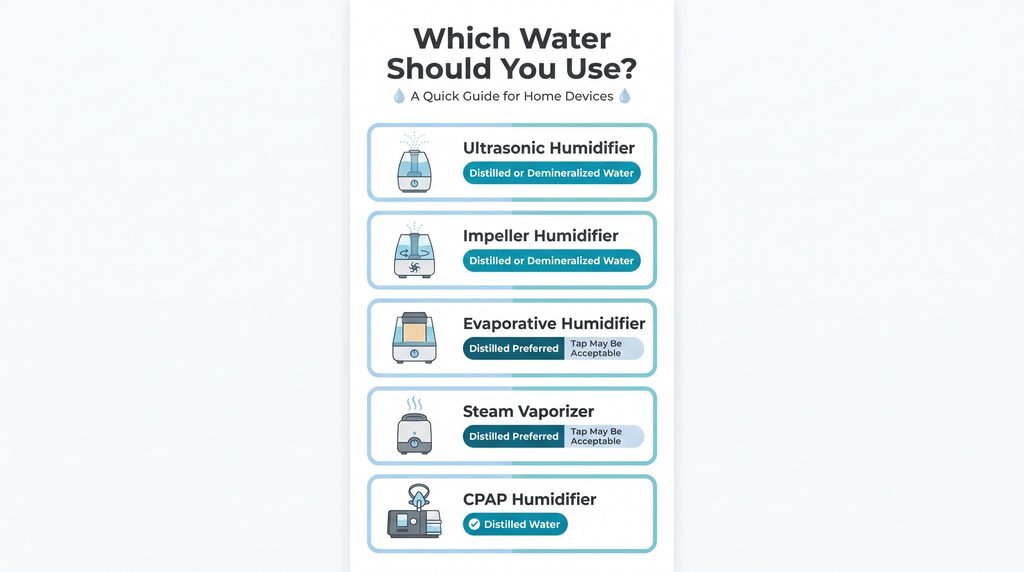
If you have an evaporative humidifier or steam vapouriser using distilled water can be helpful but is not essential. This type of humidifier draws air through a damp filter or boils the water to create steam meaning less minerals will go airborne. Tap water can leave deposits inside the tank, on the heating element or wick.
If using a CPAP humidifier you should use distilled water unless your device manufacturers specifically state otherwise. This will help reduce the amount of deposits in the humidifier chamber and make it easier to keep the equipment clean.
Water choice by humidifier type
| Humidifier type | Best water choice | Why |
|---|---|---|
| Ultrasonic cool-mist humidifier | Distilled water or demineralized water | Can release minerals from tap water into the air as white dust. |
| Impeller cool-mist humidifier | Distilled water or demineralized water | Can also disperse tank minerals into the room. |
| Evaporative humidifier | Distilled water is ideal; tap water may be acceptable | Minerals mostly stay in the wick or filter, but scale can still develop. |
| Steam vaporizer | Distilled water is ideal; tap water may be acceptable | Boiling reduces airborne minerals, but mineral scale can still form. |
| CPAP humidifier | Distilled water | Helps reduce mineral deposits in the humidifier chamber. |
Simple rule to remember
- Ultrasonic or impeller humidifier? Use distilled or demineralized water.
- Evaporative or steam humidifier? Distilled water is best, but clean tap water may be acceptable if the manufacturer allows it.
- CPAP humidifier? Use distilled water unless your manual says otherwise.
- Hard water at home? Choose distilled water more often, regardless of humidifier type.
While using distilled water will help to reduce any issues with minerals, you should still empty and clean your humidifier’s tank daily. Follow the manufacturers guidelines to ensure that no scale or skin is formed. The CPSC recommend emptying your portable humidifier’s tank daily and refilling with distilled or de-mineralised water when possible.
Why Does My Humidifier Leave White Dust?
White dust from a humidifier is usually caused by mineral build-up in the water. Tap water often contains minerals such as calcium and magnesium which dissolve in the water.
Some humidifiers create a fine mist using the tap water which means the minerals in the water are spread in the air as tiny droplets. Once the moisture has evaporated it leaves behind a white powdery mineral residue on surfaces around the room.
This is most common with cool mist humidifiers such as ultrasound or impeller humidifiers that spray the water from the tank into the room. The harder the tap water, the more minerals will be dissolved and the more white dust you will likely see.
What causes white dust?
| Cause | How it creates white dust | Where it is most common |
|---|---|---|
| Hard tap water | Calcium, magnesium, and other dissolved minerals become airborne with the mist and settle after the water evaporates. | Ultrasonic and impeller humidifiers |
| High-mineral bottled water | Spring, mineral, and some purified waters may still contain minerals that leave residue. | Any humidifier that creates mist directly from the tank |
| Ultrasonic technology | High-frequency vibrations break water into extremely fine droplets, carrying minerals into the air. | Ultrasonic humidifiers |
| Impeller technology | A rotating disc flings water into a fine mist, which can also carry minerals into the room. | Impeller humidifiers |
| Infrequent cleaning | Mineral deposits build up inside the tank and on internal parts, making residue and scale worse over time. | All humidifier types |
Why ultrasonic humidifiers cause the most white dust
Ultrasonic humidifiers use a vibrating metal plate to produce an extremely fine mist. This means that minerals do not get filtered out of the water. When each tiny droplet of water evaporates the minerals left behind are in the form of fine white particles.
This means that even though your humidifier may be working perfectly you may find dust on your TV stand, nightstand, windowsill or dark furniture. This is usually caused by the amount of minerals in your water.
Is white dust harmful?
White dust is mainly made up of minerals, however if you are using an ultrasonic or impeller model then these can spread the minerals found in tap water into the air within your home. To help reduce the amount of minerals you are exposed to by using distilled or demineralised water.
If you see large amounts of dust then switch to using distilled or demineralised water instead of tap water. You should also regularly clean your humidifier as over time the minerals can build up and cause problems with keeping your humidifier clean.
How to stop white dust from a humidifier?
- Use distilled water. If this isn’t available then use demineralized water. This also has low mineral content.
- If your model of humidifier allows use a demineralisation cartridge. Replace at the recommended intervals by the manufacturer.
- Wipe out the tank and ultrasonic plate regularly. This will stop the build up of scale.
- Don’t use spring or softened water as they can cause a residue.
- Try to place your humidifier away from electronic devices and dark surfaces to keep the dust down.
In summary, white dust is usually caused by the minerals being emitted into the air. The easiest and most effective solution for ultrasonic or impeller humidifiers is to use distilled water.
How to Prevent White Dust From a Humidifier
The best way to avoid white dust is to simply stop using mineral heavy water for your humidifier. Using distilled or demineralised water and cleaning it regularly will help with the problem. If you are using an ultrasonic or impeller humidifier, you should follow the manufacturer’s instructions for replacing the demineralisation cartridge.
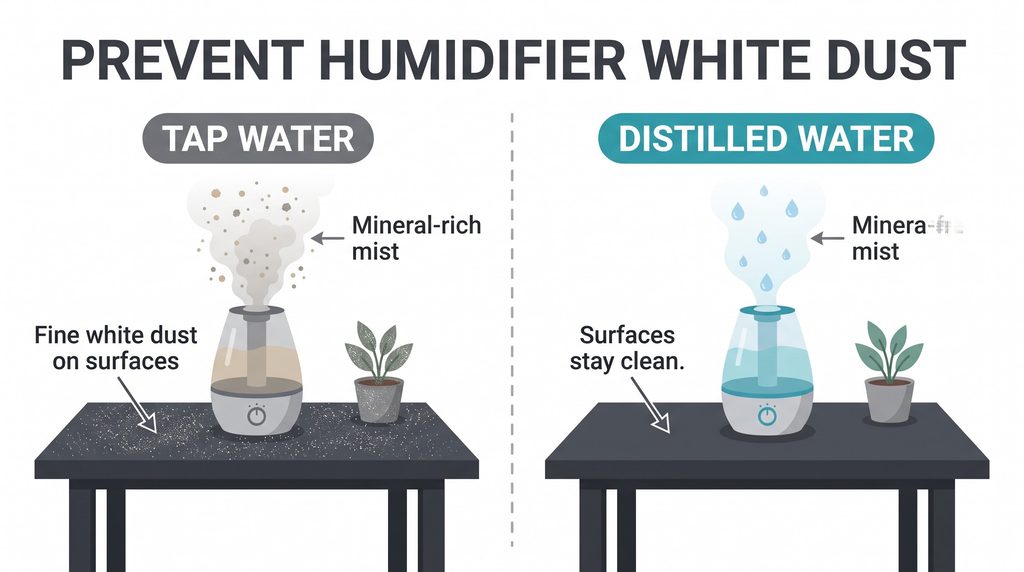
Sometimes just cleaning your room won’t help as white dust will be added to your room each time the humidifier is used if you are using hard tap water. The aim is to cut down on the amount of minerals going into the air by reducing them at the source. This should help reduce scale on your humidifier.
1. Use distilled or demineralized water
For ultrasonic and impeller humidifiers it is best to use distilled water. This has very few dissolved minerals so there will be less white dust. If you can’t get distilled water, demineralized water will work as well.
Don’t assume all bottled water is low in minerals. Spring, mineral water and some purified waters may still contain dissolved minerals. Check the label and choose a water that says distilled or demineralized.
2. Use a demineralization cartridge
If your humidifier has a demineralization cartridge or allows you to install one, install the cartridge.
Replace the cartridge as advised by the manufacturer. An old or full cartridge will not provide the best control of minerals and can cause white dust and affect the performance of your humidifier.
3. Clean the humidifier regularly
Minerals may build up to cause scaling. Scaling can cause a hard, crusted deposit to form on the tank, ultrasonic plate, heating element or other components. This can be harder to clean and will create areas for bacteria/fungi to grow.
A simple maintenance routine:
- Daily: Empty leftover water, rinse the tank, and refill with fresh water.
- Every 2–3 days: Clean the tank and any parts that hold water.
- Weekly: Inspect for scale, film, or residue and deep-clean if needed.
- Before storage: Clean and dry every removable part completely.
Always unplug the humidifier before cleaning and follow the manufacturer’s instructions for your specific model.
4. Remove existing mineral scale
If there is any white dust, make sure to clean your humidifier before switching between different water types. This will prevent any old mineral build-up flaking off.
A popular method is to use a diluted white vinegar solution to help break down the mineral scale. Once the scale has been broken down, leave the humidifier to soak. Follow any instructions on the product or cleaning instructions. Gently scrub with a soft brush and rinse well. The CPSC recommend that you should use a soft brush or towel and vinegar solution to remove any scale or mineral build up.
Avoid using harsh abrasive or cleaning products which could cause damage to the tank, ultrasonic plate, seals and sensors.
5. Avoid softened water
A water softener will reduce the hardness minerals in the water but may add either sodium or potassium. This can mean the water is still left with deposits.
If you have softened water in your home you should not assume it is the same as distilled water. It is still best to use distilled or demineralised water with ultrasonic and impeller humidifiers.
6. Keep the humidifier away from sensitive surfaces
Even with improved water quality you should still place your humidifier away from electronic items, wooden furniture, walls and dark surfaces. This will help reduce the amount of visible mineral dust but will not eliminate it.
Use a washable mat or tray under the humidifier if white dust has been a recurring problem.
Quick prevention checklist
| Action | How often | Why it helps |
|---|---|---|
| Use distilled or demineralized water | Every refill | Reduces minerals that cause white dust |
| Empty and rinse the tank | Daily | Prevents stale water and mineral concentration |
| Clean the tank and water-contact parts | Every 2–3 days | Removes film and early scale |
| Descale mineral deposits | As needed | Restores performance and reduces residue |
| Replace demineralization cartridge | Per manufacturer instructions | Keeps mineral reduction effective |
| Avoid tap water in ultrasonic/impeller models | Ongoing | Prevents the main cause of white dust |
Use distilled or demineralised water in your ultrasonic or impeller humidifier. This will help to avoid white dust. Always clean your humidifier and remove any scale. Using distilled water will reduce the amount of minerals and cleaning will stop any build up.
Humidifier Cleaning Tips
While distilled water helps reduce mineral build-up, you will still need to clean your humidifier. If left for too long, or not looked after, the water tanks can cause a build-up of film, bacteria, mould and residue. The EPA recommends that you should empty, dry and fill your portable humidifier daily. You should also clean it every 3 days.
Follow the instructions provided by your humidifier company, as each model will vary in tank, filter, ultrasonic plate, wick and cleaning.
Daily cleaning routine
- Turn off and unplug the humidifier.
- Empty all leftover water from the tank and base.
- Rinse the tank with clean water.
- Wipe the inside dry with a clean cloth or let it air-dry.
- Refill with fresh distilled or demineralized water before the next use.
Do not let water sit in the tank overnight or for several days. Standing water can encourage film and microbial growth, especially in warm indoor environments.
Every three days: deeper clean
For regular use, clean the humidifier about every three days. This helps remove early mineral deposits, biofilm, and residue before they become difficult to remove.
- Unplug the unit and disconnect the tank.
- Empty any remaining water.
- Rinse the tank and removable parts with clean water.
- Clean surfaces that hold water using a manufacturer-approved method.
- Scrub away film, scale, or deposits with a soft brush or cloth.
- Rinse thoroughly until no cleaning solution remains.
- Dry all parts before reassembling or storing the humidifier.
How to remove mineral scale
If you see white crust, cloudy film, or hard deposits, you are likely seeing mineral scale. A diluted white vinegar solution can help loosen it.
- Mix equal parts white vinegar and water, unless your manufacturer recommends a different method.
- Fill the tank or apply the solution to affected areas.
- Let it sit for the time specified by the manufacturer or cleaning guidance.
- Gently scrub scale with a soft brush or cloth.
- Rinse all parts thoroughly with clean water.
- Dry completely before reuse.
The CPSC recommends removing scale and mineral deposits with a soft brush or towel and a vinegar solution.
Avoid abrasive pads, steel wool, or harsh scrubbing on ultrasonic plates and sensors. These parts can be damaged easily.
What to avoid when cleaning
- Do not use bleach unless the manufacturer specifically instructs it. Some cleaning guidance warns that bleach fumes can irritate the lungs.
- Do not mix cleaning chemicals. Never combine vinegar with bleach or other cleaners.
- Do not submerge the entire humidifier unless the manual says it is safe.
- Do not use scented cleaners or essential oils unless the manufacturer approves them; they can leave residue or damage components.
- Do not skip rinsing. Cleaning solution left in the tank can enter the mist.
Filter and cartridge care
If your humidifier uses a wick, filter, or demineralization cartridge:
- Check it regularly for discoloration, hardness, odor, or mineral buildup.
- Replace it according to the manufacturer’s schedule.
- Do not try to clean a disposable filter indefinitely; a worn filter may not perform properly.
- Replace cartridges on time, especially if you previously used tap water.
Distilled water can slow mineral buildup, but filters and cartridges still need replacement over time.
Before storing your humidifier
When the humidifier will not be used for a while:
- Empty all water from the tank and base.
- Clean and rinse every removable part.
- Remove mineral scale if present.
- Let every component dry completely.
- Store the unit in a dry place.
- Remove or replace used filters and cartridges as recommended.
Cleaning and fully drying the humidifier before storage helps prevent stale-water odor, residue, and microbial growth.
Simple cleaning schedule
| Task | Frequency | Purpose |
|---|---|---|
| Empty, rinse, dry, and refill tank | Daily | Prevents standing water and residue |
| Clean tank and water-contact parts | Every 3 days | Removes film, deposits, and early scale |
| Descale with vinegar solution | As needed | Removes hardened mineral buildup |
| Check or replace filter/wick | Per manufacturer guidance | Maintains performance and hygiene |
| Deep-clean before storage | Before long-term storage | Prevents odor, mold, and residue |
Ultimately, using distilled water will reduce mineral buildup. To help prevent film, scale and microbial growth, you should clean your humidifier regularly. As a general rule, emptying and drying your humidifier daily and cleaning every three days is a good starting point for most portable humidifiers.
Safe Disinfectants for Humidifiers
It is advisable to refer to your humidifier manufacturers guidelines when cleaning. Always use products they recommend. White vinegar is often recommended to help descale your unit.
Some units can be cleaned with diluted odourless bleach or an EPA registered disinfectant but always follow the manufacturers instructions. Never mix cleaning products. Ensure you rinse off well and ensure the unit is completely dry before re-use.
It is important to understand that disinfecting isn’t the same as descaling. The vinegar will help break down the scale whereas a disinfectant should reduce the number of germs. If there appears to be any scale, it is advised to remove this first. Disinfectants work best on clean surfaces.
Safe options by cleaning goal
| Cleaning goal | Safer option | How to use it | Important caution |
|---|---|---|---|
| Remove mineral scale | White vinegar diluted with water | Follow the manufacturer’s guidance; soak or wipe affected areas, scrub gently, then rinse thoroughly | Do not use on materials the manual says are vinegar-sensitive |
| Reduce germs on approved surfaces | Diluted unscented household bleach | Use only if the humidifier manual permits bleach; follow the product label for dilution and contact time | Never mix bleach with vinegar, ammonia, or other cleaners. |
| Reduce germs on approved surfaces | EPA-registered disinfectant | Use only if labeled safe for the humidifier’s materials and follow the label exactly | Confirm the product is appropriate for plastics and water-contact parts |
| Routine cleaning | Mild dish soap and water | Wash removable parts if the manual allows, then rinse and dry completely | Soap removes residue but is not a disinfectant |
Using white vinegar safely
White vinegar is a useful descaling agent that can help break down calcium and magnesium deposits. It can usually be used to clean humidifier tanks and detachable parts. Always follow manufacturers guidelines.
- Unplug and empty the humidifier.
- Fill the tank with a vinegar-and-water solution if the manual permits it, or apply it to affected areas.
- Let it sit for the recommended time.
- Gently scrub scale with a soft brush or cloth.
- Rinse all parts thoroughly with clean water.
- Air-dry completely before reassembly.
Do not assume vinegar disinfects as effectively as an EPA-registered disinfectant. Its main value here is descaling, not germ control.
Using bleach safely
Some humidifier manufacturers allow a diluted bleach solution for disinfecting. If yours does, use plain, unscented household bleach and follow the product label exactly.
Dilution and contact time vary by model, so follow your humidifier manufacturer’s instructions exactly and rinse thoroughly afterward.
Safety rules for bleach:
- Never mix bleach with vinegar, ammonia, alcohol, or other cleaners. Mixing can release dangerous vapors.
- Ventilate the room while cleaning.
- Wear gloves and eye protection if recommended by the product label.
- Keep children and pets away until the area is ventilated and surfaces are dry.
- Rinse the humidifier thoroughly after disinfecting.
- Do not add bleach to the water tank during normal operation. It is for cleaning only if the manufacturer approves it.
Hydrogen peroxide: use caution
If you use hydrogen peroxide:
- Use only the concentration and contact time specified by the humidifier manufacturer.
- Do not mix it with vinegar or bleach.
- Rinse thoroughly afterward.
- Stop using it if the manual does not explicitly allow it.
Cleaning guidance should always take priority over general online recommendations.
What not to use
Avoid these unless your humidifier manufacturer specifically approves them:
- Essential oils
- Fragranced cleaners
- Fabric softeners
- Harsh abrasives or steel wool
- Undiluted bleach
- Mixed cleaning chemicals
- Unknown “disinfectant” products without clear label directions
The essential oils and scented products can leave a residue, damage plastic components and affect the amount of mist created. Abrasive tools can cause scratches on the tanks and ultrasonic plates causing build-up of residue and bacteria.
Rinse and dry every time
After using any cleaner or disinfectant:
- Rinse all water-contact parts thoroughly with clean water.
- Repeat the rinse if you can still smell the cleaner.
- Wipe surfaces dry or allow them to air-dry completely.
- Reassemble only when every part is dry.
- Refill with fresh distilled or demineralized water.
The CDC notes that germs can live in humidifiers unless water is emptied daily, the unit is cleaned regularly, and it is allowed to air-dry after cleaning.
Use vinegar to remove mineral deposits. If you want to use bleach or an EPA registered disinfectant, check with the humidifier manufacturer. The safest option is to clean your humidifier, following the disinfectant instructions, then thoroughly rinse and dry. Refill with fresh distilled water.
What Is Distilled Water?
Distilled water is produced by boiling water until it becomes steam. This steam is then cooled to form liquid water again. Due to this process most of the dissolved minerals will be removed from the water, leaving it with much lower levels of minerals than tap water.
Although distilled water isn’t typically completely free of minerals, it has significantly lower levels of minerals than most tap water. This makes it less likely to produce white dust, scaling and makes it easier to clean. Distillation is the most effective way of removing minerals according to the EPA.
How distilled water is made
- Water is heated until it turns into steam.
- The steam leaves behind most dissolved minerals and impurities.
- The steam is cooled and collected as distilled water.
- The finished water is stored in a clean container.
Unlike a water filter to help with taste and reduce some of the contaminants, a filter will not remove the dissolved minerals causing the build-up of scale in your humidifier and white dust.
Why use distilled water in your humidifier?
Using distilled water in a humidifier can help to avoid any issues caused by minerals. This is particularly useful for ultrasonic and impeller humidifiers. These humidifiers produce a fine mist directly from the water in the tank causing any minerals in the tap water to be released into the air.
Reduces white dust
Calcium, magnesium and other soluble minerals can be found in tap water. Using an ultrasonic or impeller humidifier means that these minerals can be released along with the mist leaving behind a white dusty residue on your furniture, flooring and electronic items.
Avoids scaling
Taps water can cause scaling (crusty deposits) to occur in the tank and on the internal components of your humidifier. This can cause extra difficulty when trying to clean your machine.
May reduce the need to clean
Although using distilled water will not completely remove the need to clean your humidifier, it can reduce the build up of minerals. However, you should still regularly drain, rinse and clean your humidifier.
A better option for mist creating humidifiers
Ultrasonic and impeller humidifiers release water directly from the tank into the room so having low mineral water is really important. The EPA mention that these types of humidifiers are extremely efficient at distributing minerals from tap water into the air.
Do All Humidifiers Require Distilled Water?
Not all humidifiers require distilled water, however it is most important to use it with ultrasonic and impeller humidifiers but can be beneficial to almost all types.
Ultrasonic humidifiers
Require distilled or demineralised water. These work by using vibrations to create a fine mist. Tap water contains minerals which can cause white dust to be released into the air.
Impeller humidifiers
Require distilled or demineralised water. These also use the minerals in the tank and release them into the air.
Evaporative humidifiers
Distilled water is useful but not essential. These work by using air to pass through a wet wick/filter. More minerals will be retained within the machine, however scaling can still occur using tap water.
Steam vaporisers
Distilled water is useful but not essential. As the water is boiled to create steam, the minerals are less likely to be released, however scaling can occur.
CPAP humidifiers
Require distilled water unless your CPAP manufacturer advise otherwise. It helps to reduce any mineral build up within the humidifier chamber and makes it easier to keep your equipment clean.
Distilled Water vs Tap Water for Humidifiers
It is best to use distilled water in your humidifier. Tap water contains more minerals and can cause a white dust to build up. This can cause scaling and more cleaning. Especially with ultrasonic and impeller models.
What happens if you use tap water?
- White dust may collect on nearby surfaces.
- Mineral scale can build up inside the tank and on parts.
- Filters and wicks may clog or wear out faster.
- The humidifier may need more frequent cleaning.
- In ultrasonic and impeller models, minerals can become airborne.
When tap water may be acceptable
Some evaporative humidifiers and steam vaporizers can be used with tap water (if manufacturer allows). If using tap water you should clean the humidifier more frequently and look out for limescale and white deposits.
When to avoid tap water
Avoid tap water in ultrasonic humidifiers, impeller humidifiers, and CPAP humidifiers unless the manufacturer explicitly says it is acceptable. These devices benefit most from low-mineral water.
Distilled vs Demineralized vs Purified vs RO Water
| Water type | Mineral level | Good for humidifiers? | Notes |
|---|---|---|---|
| Distilled water | Very low | Best overall choice | Made through distillation; EPA describes it as the most effective mineral-removal method. |
| Demineralized water | Very low | Excellent alternative | Often made through deionization or reverse osmosis; may contain slightly more minerals than distilled water. |
| RO water | Usually low | Usually good | Quality depends on the RO system and membrane condition. |
| Purified water | Varies | Check the label | “Purified” does not always mean low-mineral. |
| Filtered pitcher water | Medium to high | Not a substitute | May not remove hardness minerals. |
| Spring water | Medium to high | Not recommended | Often contains minerals that cause white dust and scale. |
| Softened water | Lower hardness, but may contain sodium | Not recommended | Can still leave residue. |
| Boiled tap water | Minerals become concentrated | Not equivalent to distilled | Boiling does not remove dissolved minerals. |
Can You Use Bottled Water in a Humidifier?
Yes, but only if it states on the label that it is distilled or demineralised. Using bottled distilled water is one of the easiest ways to use water in your humidifier. It will provide you with a consistent and convenient source of low mineral water.
Spring water
You should avoid using spring water in your humidifier. It often contains natural minerals that can leave a white dust and scale.
Purified drinking water
This may be acceptable but depends on the treatment process. Check the label to see if it is stated as distilled or demineralised. If it is not then it may still contain some minerals.
Can You Use Softened Water in a Humidifier?
Softened water is not the same as distilled water. Whilst a water softener will remove the minerals that cause hardness it may add sodium or potassium. This can still leave some residue.
Instead choose distilled or demineralised water for your ultrasonic or impeller humidifier. However, if your humidifier manual specifically says you can use softened water then do so. Be sure to clean regularly.
Can You Use Boiled Water Instead of Distilled Water?
No. Boiled water is not a suitable substitute for distilled water.
Whilst boiling will kill some microbes, it won’t remove the minerals that are dissolved in the water. In fact boiling will concentrate the minerals as some of the water will evaporate. This means that boiled tap water may still cause white dust and scale.
Use distilled or demineralised water if your humidifier requires low mineral water.
Can You Make Distilled Water at Home?
Yes, you can make distilled water at home by boiling water and collecting the condensed steam. However, it takes time, uses energy, and requires clean equipment to avoid contamination.
Basic home method
- Heat water in a clean pot until it produces steam.
- Capture the steam and allow it to cool into a clean container.
- Store the collected water in a clean, covered container.
Is homemade distilled water safe for humidifiers?
It can be, if it is made and stored properly. For regular humidifier use, though, store-bought distilled water is usually more convenient and consistent.
How to Use Distilled Water in a Humidifier
- Read your humidifier manual before changing water types.
- Empty any old water from the tank.
- Rinse the tank with clean water.
- Fill it with fresh distilled water to the manufacturer’s fill line.
- Run the humidifier normally.
- Empty unused water daily.
- Clean the unit regularly and dry it between uses when possible.
Do not mix fresh distilled water with old water. Emptying and refilling daily helps prevent standing water and residue.
Is Distilled Water Safe to Breathe From a Humidifier?
Using distilled water as this has a low mineral content is often recommended. However, even with clean water, you will still need to keep your humidifier clean, by changing the water every day and ensuring it is dry.
If you have asthma, allergies or any other respiratory issues please follow the manufacturers guidelines for your humidifier and seek advice from a health care professional.
Distilled Water for Humidifiers: Pros and Cons
Pros
- Reduces white dust.
- Helps prevent mineral scale.
- May extend filter and component life.
- Makes cleaning easier.
- Especially useful for ultrasonic, impeller, and CPAP humidifiers.
Cons
- Costs more than tap water.
- Requires regular purchasing or home production.
- Does not replace cleaning.
FAQs About Distilled Water for Humidifiers
Can I use tap water in my humidifier?
It depends. Some evaporative or steam humidifiers can use tap water but distilled water is best to use in an ultrasonic or impeller humidifier.
Should I use distilled water in my humidifier?
Not always, but it is recommended to use distilled water in an ultrasonic/impeller humidifier. It is a good option for CPAP humidifiers and if you have hard water.
What can I use instead of distilled water in my humidifier?
Demineralised water would be the best option. Depending on the mineral content, RO water may be suitable.
Is demineralised water the same as distilled water?
No, they are different. Both are low in minerals, however distilled water is created using distillation. Demineralised water can be created using a variety of methods such as deionisation or reverse osmosis.
Why is there white dust coming out of my humidifier?
The white dust is usually caused by minerals in the tap water being released into the air. This is most common with ultrasonic or impeller humidifiers.
How often should I clean my humidifier?
Daily empty and rinse the water tank. Clean the humidifier every 3 days or so if being used regularly. Check manufacturers guidelines.
Can bacteria grow in distilled water?
Yes. Although there are less minerals in distilled water, bacteria can still grow in the tank, water or container. Ensure you clean and dry your humidifier regularly.
Should I use distilled water in my CPAP humidifier?
Usually yes. Check the manufacturers guidelines for your CPAP but it is commonly recommended to use distilled water to reduce mineral build up.
Will using distilled water stop mould growing in my humidifier?
It can help reduce mineral build up but to stop mould growing you should empty the tank daily, clean regularly and ensure it is dry. Replace filters if required.
Final Recommendation
For ultrasonic, impeller and CPAP humidifiers always use distilled water. If you cannot get distilled water, use demineralised water. For evaporative and steam vapourisers, using distilled water is still ideal. However, if your manufacturer allows it, using tap water may be acceptable as long as you regularly clean your device.
No matter what type of water you choose to use, you should empty your tank every day and regularly clean and dry your humidifier. Using distilled water will reduce mineral build up and cleaning your humidifier properly will ensure it is safe and working well.






Really appreciated the systematic breakdown presented in “distilled water for humidifier”. Thank you for sharing such a constructive piece—definitely a valuable reference for anyone following this field.
[…] whether your humidifier or other household water uses call for a different water type, our piece on distilled water for humidifiers is a useful side read, and if you are weighing a portable filter for backup or travel, see our […]
[…] humidifier shows it. Hard-water minerals become airborne white dust, which is why people switch to distilled water for a humidifier. A softener fixes that at the […]
[…] If hardness, iron, or manganese runs high, you’re looking at treatment, and sizing matters. Our whole-home water softener sizing, costs, and legal limits guide walks through the numbers. Hard well water also leaves mineral dust when used in appliances, which is why we cover distilled water for humidifiers. […]
[…] Carbon-filtered water is also not mineral-free. If you run a humidifier, you still need to deal with minerals, so see distilled water for humidifiers. […]
[…] guide. For appliance-specific water questions, such as steam or humidifier use, see our guide to distilled water for humidifiers. Order the analysis, then choose the […]