

By Amir Hamza, founder of WaterVelor · Sources reviewed November 21, 2026 · Educational content, not legal or professional advice.
Well water testing in Rhode Island is built into the home sale. State rules require a test before a property with a private well is sold or transferred, and your contract must give you 10 days to do it. Miss that window and you lose leverage. This guide walks buyers through the law, the required tests, lab prices, sampling steps, and what to do if results fail.
Key Takeaways
- Testing is required before a Rhode Island home with a private well is sold or transferred.
- Your contract must give you 10 days to test, unless both sides agree to a different period.
- The buyer pays by default. A written agreement can shift the cost.
- You can void the contract by written notice before closing if the clause is missing, prior results are withheld, or results exceed state limits.
- State lab kits cost $95, $280 or $410. PFAS adds $200.
- Results usually take 10–15 business days, so ask for an extension early.
- State lab drop-off is Monday–Thursday only.
- PFAS isn’t required. Rhode Island advises treatment above 20 ppt (six-compound total).
New to buying a home with a well? Start with our buying a house with a well checklist, then come back here for the Rhode Island rules.
Well Water Testing Rhode Island Law: What Buyers Must Know
Rhode Island requires private well water testing before a home is sold or transferred. Your contract must give you a 10-day testing window, you pay for sampling and analysis unless you agree otherwise in writing, and you can void the deal by written notice before closing if results exceed limits.
Here is what R.I. Gen. Laws § 5-20.8-12 says:
- The window: 10 days, or another period both sides agree to.
- The cost: The buyer pays for collection, analysis and a qualified opinion on potability, unless the contract says otherwise in writing.
- Prior results: The seller must provide earlier test results. The state’s private well regulation says owners must make the past ten years of reports available to buyers.
- Your exit: You can void the contract by written notice before closing if the testing clause is missing, prior results are withheld, or results exceed state limits.
- No title defect: A missing clause or missing results doesn’t cloud the title. It gives you the right to walk.

The same regulation also requires testing before a certificate of occupancy and for a new well serving an existing building.
Who can collect and test the water?
Three roles handle a sale test. Use all three.
| Role | What they do | Where to find them |
|---|---|---|
| Sampler | Collects the samples | RIDOH’s list of licensed samplers and interpreters, linked on URI’s realtor page |
| Certified laboratory | Analyzes the water | RIDOH’s certified lab list |
| Licensed interpreter | Compares results to standards, writes a letter report, and reports detections to RIDOH within 15 days | Same RIDOH list |
URI Tip Sheet 28 tells buyers to use licensed experts for all three steps. Ask your home inspector to arrange it.
Which Tests Does a Rhode Island Home Sale Require?
The state minimum panel covers alkalinity, total coliform and E. coli, hardness, chloride, fluoride, iron, lead, manganese, nitrate and nitrite, pH, specific conductance, sulfate, total dissolved solids, turbidity, regulated VOCs, and MTBE. Your local building official can also require additional tests.
| Test | What it flags | Benchmark used |
|---|---|---|
| Total coliform and E. coli | Septic or surface-water contamination | Absent |
| Nitrate / nitrite | Fertilizer, septic waste; infant risk | 10 mg/L / 1 mg/L as nitrogen |
| Lead | Plumbing and solder; sampled first-draw | 15 µg/L EPA action level |
| Iron / manganese | Stains and metallic taste | 0.3 / 0.05 mg/L (secondary) |
| pH | Corrosive or scale-forming water | 6.5–8.5 (secondary) |
| Chloride, sulfate, TDS | Road salt, minerals, taste | 250 / 250 / 500 mg/L (secondary) |
| Fluoride | Natural bedrock sources | 4.0 mg/L (primary) |
| Alkalinity, hardness, conductance | Scale, corrosion, mineral load | No health limit |
| VOCs | Fuel and solvents | Varies; benzene is 5 µg/L |
| MTBE | Gasoline additive | 40 µg/L state advisory |
The regulation applies public drinking water standards to private wells. See EPA’s drinking water regulations for the full list.
How Much Does Well Water Testing Cost in Rhode Island?
The State Health Laboratories charge $95 for the annual kit, $280 for the 3–5 year kit, and $410 for the full 5–10 year kit. PFAS testing adds $200. Private labs set their own prices, and licensed sampler and interpreter fees cost extra.
| Kit | Price | What it adds |
|---|---|---|
| Kit A (annual) | $95 | Coliform, nitrate, nitrite, color, chloride, sodium, turbidity |
| Kit B (3–5 year) | $280 | Kit A plus alkalinity, hardness, fluoride, iron, lead, manganese, pH, conductance, sulfate, TDS, copper, zinc and more |
| Kit C (5–10 year) | $410 | Kits A and B plus VOCs, TPH and MTBE |
Kit C appears to cover every parameter on the state’s minimum list. Confirm with the lab that it fits a sampler-collected sale sample.
How Long Do You Have, and How Long Do Results Take?
You get 10 days unless both sides agree to a different period. RIDOH says results usually take 10 to 15 business days, so a full panel can outlast your window. Ask the seller for a written extension on day one.
| When | What to do |
|---|---|
| Day 0 | Find the testing clause. Ask your attorney whether days are calendar or business days. |
| Day 1 | Request all prior test reports in writing. Book a sampler and a certified lab. |
| Days 2–4 | Collect and deliver samples, Monday through Thursday. |
| Days 4–7 | Negotiate a written extension if the lab can’t finish by day 10. |
| Before closing | Get the interpreter’s letter report. Send written notice if results fail. |
Water Well Testing Procedure: How to Collect a Clean Sample
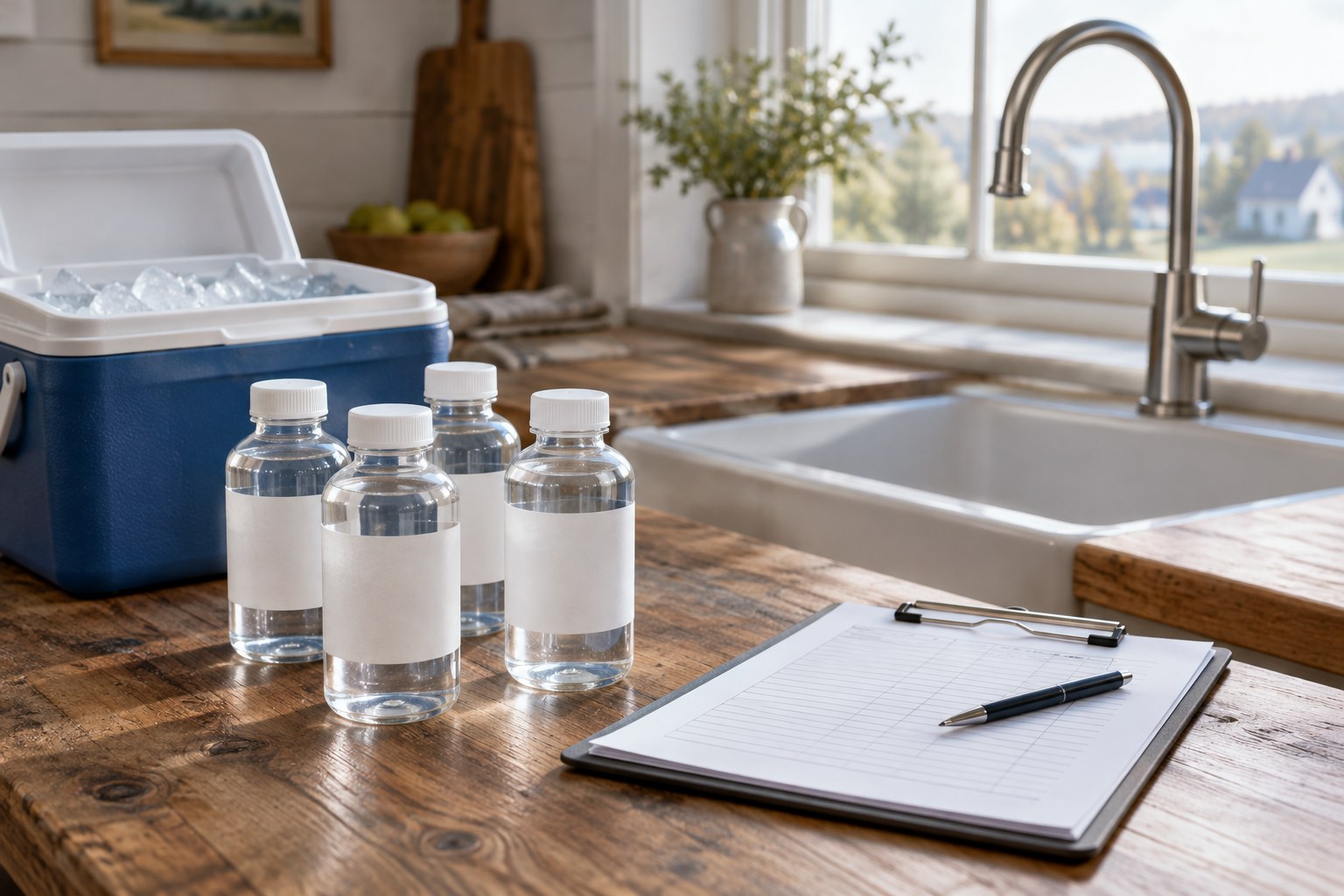
Hire a licensed sampler, use the certified lab’s bottles, and collect from a cold tap ahead of any treatment. Don’t rinse the bottles, keep them cold, and deliver them Monday through Thursday with a completed chain of custody form. Follow your lab’s printed instructions first.
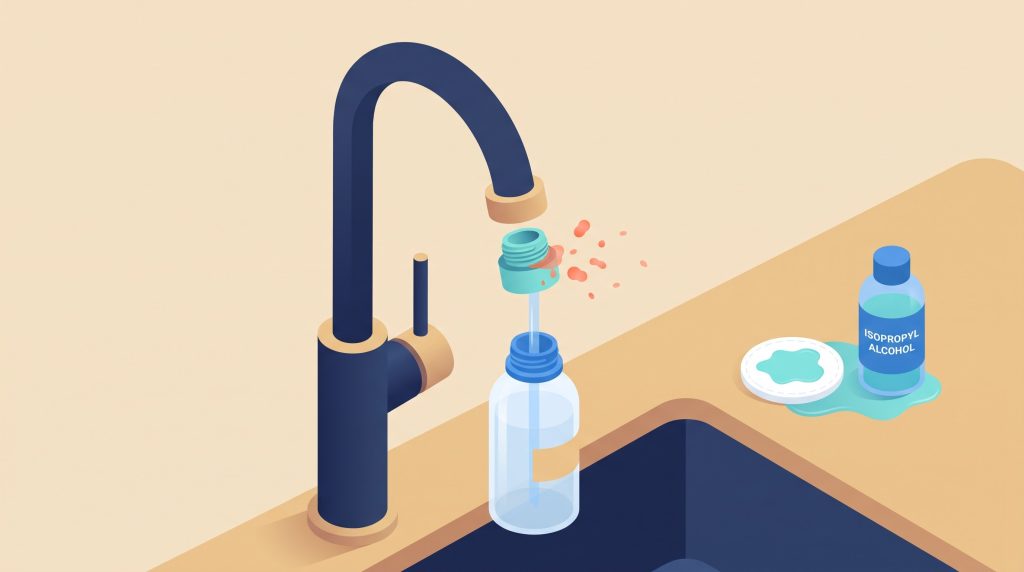
For a sale, let the sampler do the work. These steps show what good collection looks like. RIDOH says most samples take 5 to 10 minutes.
- Pick the tap. Use a cold tap near the pressure tank, before any softener, filter or UV unit.
- Collect the lead bottle first. The regulation requires a first-draw cold-water sample, so no flushing beforehand.
- Clean the spout. Remove the aerator and wipe the spout with alcohol if your lab says so.
- Flush the line. Run cold water about five minutes before filling the other bottles.
- Fill without touching. Use a pencil-thin stream. Keep fingers off the cap and rim. Don’t rinse the bottles, because many hold a preservative.
- Label everything. Match name, address, date and exact time to the chain of custody form.
- Keep it cold. Use bagged ice, never frozen. If you add PFAS, skip ice packs and permanent markers, and follow RIDOH’s PFAS kit instructions.
Don’t sample after a plumbing repair, during flooding, or from a tap with a filter attached. For more detail, see our step-by-step well water sampling guide.
Where to Drop Off Samples: Rhode Island Labs
| Lab | Address | Phone | Notes |
|---|---|---|---|
| RI State Health Laboratories | 150 Richmond St, Suite 100, Providence | 401-222-6064 | Drop-off Monday–Thursday. No Fridays or the day before a state holiday. Pay at drop-off. |
| Rhode Island Analytical | 41 Illinois Ave, Warwick | 401-737-8500 | Listed by RIDOH as a certified PFAS lab |
| ESS Laboratory | 185 Frances Ave, Cranston | 401-461-7181 | Listed by RIDOH as a certified PFAS lab |
RIDOH’s well-testing page lists state lab hours of 8:30–3:30. The order form says 4:30. Call before you go. The lab moved to Richmond Street in 2025 and briefly paused private well samples, so confirm it’s accepting them. Check each private lab’s certification for all required parameters.
Should You Test for PFAS, Arsenic or Radon?
Does Rhode Island require PFAS testing when buying a house?
No. PFAS isn’t on the state’s required list for a sale, but buyers can add it. RIDOH recommends testing near suspected sources. The Rhode Island health limit is 20 parts per trillion for the total of six PFAS compounds, and the state advises treatment above that level.
| PFAS total (six compounds) | RIDOH guidance |
|---|---|
| None detected | No specific retest schedule |
| Under 10 ppt | Include in the 5–10 year panel |
| 10–20 ppt | Include in the 3–5 year panel; consider treatment |
| Over 20 ppt | Install treatment and retest |
EPA’s 4 ppt limits for PFOA and PFOS apply to public water systems, not private wells.
RIDOH also recommends arsenic and beryllium tests in some areas. Use its online map tool. Radon and uranium aren’t on the state minimum list. Ask your sampler about them if your well draws from bedrock.
Can You Use a Home Test Kit Instead of a Certified Lab?
RIDOH tells well owners to use certified laboratories and avoid mail-in or over-the-counter kits. For a Rhode Island home sale, use a licensed sampler, a certified lab, and a licensed interpreter. A home kit works only as a quick screening step.
| Certified lab with licensed sampler | Home or mail-in kit | |
|---|---|---|
| RIDOH guidance | Recommended | Avoid |
| Chain of custody | Yes | Usually no |
| Interpreter letter report | Yes | No |
| Best use | Home sale, baseline, health decisions | Early screening of a home you like |
How to Read Your Lab Report
Rhode Island’s regulation gives interpreters a set of result terms. Use them to judge urgency.
| Term | Meaning |
|---|---|
| Present | Detected, up to 50% of the limit |
| Action Level | Over 50% of the limit, up to the limit |
| Elevated | Above the limit, under 10 times the limit |
| Extremely Elevated | 10 times the limit or more |
| Exceedance | Used for secondary (taste and stain) standards |
Your interpreter sends all detections to RIDOH within 15 days. For help with the numbers, read our guide to reading lab results against EPA limits.
What Happens If the Well Water Fails?
If results exceed state limits, you can void the contract by written notice before closing. You can also negotiate treatment or a price credit, then retest after any fix. Have your attorney review the notice wording before you send it.
| Result | Typical next step |
|---|---|
| Coliform or E. coli | Don’t drink untreated. Disinfect the well, check the cap and casing, then retest. |
| High nitrate | Use bottled water for infants. Don’t boil. Consider reverse osmosis or ion exchange. |
| Lead | Use a certified lead-removal filter and check plumbing. |
| Iron, manganese, hardness | Consider a softener or oxidizing filter. See our softener sizing guide. |
| Low pH | Consider a neutralizing filter. |
| PFAS over 20 ppt | Install treatment, then retest. |
Test before you treat. RIDOH publishes Test Before You Treat guidance for this reason. A portable filter like the one in our Sawyer Squeeze review can cover bacteria and protozoa while you wait. It won’t remove nitrate or most chemicals.
How Often Should Rhode Island Well Owners Test?
Test every year for coliform bacteria, nitrate and nitrite, color, chloride, sodium, and turbidity. RIDOH adds metals, corrosivity, and hardness every 3 to 5 years, and VOCs and MTBE every 5 to 10 years. Retest after floods, well damage, or new treatment equipment.
| How often | Tests |
|---|---|
| Every year | Coliform, nitrate/nitrite, color, chloride, sodium, turbidity |
| Every 3–5 years | Metals, corrosivity, hardness |
| Every 5–10 years | VOCs and MTBE |
| Some areas | Arsenic, beryllium, PFAS |
FAQ: Well Water Testing in Rhode Island
Is well water testing required to sell a house in Rhode Island?
Yes. Rhode Island’s private well rules require testing before a property is sold or transferred. The law also requires your contract to give you a 10-day window. The buyer normally pays, and licensed professionals handle sampling, analysis, and interpretation of the results.
Who pays for well water testing in Rhode Island?
The buyer pays for sample collection, lab analysis, and a qualified opinion on potability unless the contract says otherwise in writing. A seller can agree to cover some or all of the costs. Put that agreement in writing before you book the sampler.
Can a seller refuse to share old well test results?
A seller must provide any earlier test results. If the seller doesn’t, you can void the contract by written notice before closing. RIDOH’s regulation says owners must make the past ten years of reports available to buyers. Missing results don’t create a title defect, but they give you leverage.
Does the 10-day window mean calendar or business days?
The statute states a ten-day period and, as far as we could tell, doesn’t say how to count it. Your contract may define it. Ask your attorney or agent before you book anything, because results can take 10 to 15 business days and weekends limit lab drop-offs.
Schedule Well Water Testing in Rhode Island This Week
A buyer who tests in the first three days has choices: negotiate, treat, extend or walk. A buyer who tests on day nine has a lab report and no leverage.
Call a certified lab or licensed sampler today. Ask for the home-sale panel, book a Monday-through-Thursday drop-off, and request the seller’s past reports in writing. Order testing before you shop for equipment. A lab report tells you which fix, if any, is worth buying.
Explore more in our Water Testing guides.
Sources: R.I. Gen. Laws § 5-20.8-12 · 216-RICR-50-05-2 · RIDOH: Testing Your Well Water · State Health Laboratories order form · URI Tip Sheet 28 · RIDOH laboratory move notice



[…] a house on a well in a tight timeline? Rhode Island buyers should work through the 10-day well water testing checklist for home sales. Everyone else closing on a rural property should read the complete guide to well water testing for […]
[…] Buying a home with a well? Lenders and buyers want certified numbers, and the testing window is short. See our well water testing guide for home buyers, or, for Rhode Island sales, the 10-day home sale checklist for buyers. […]