

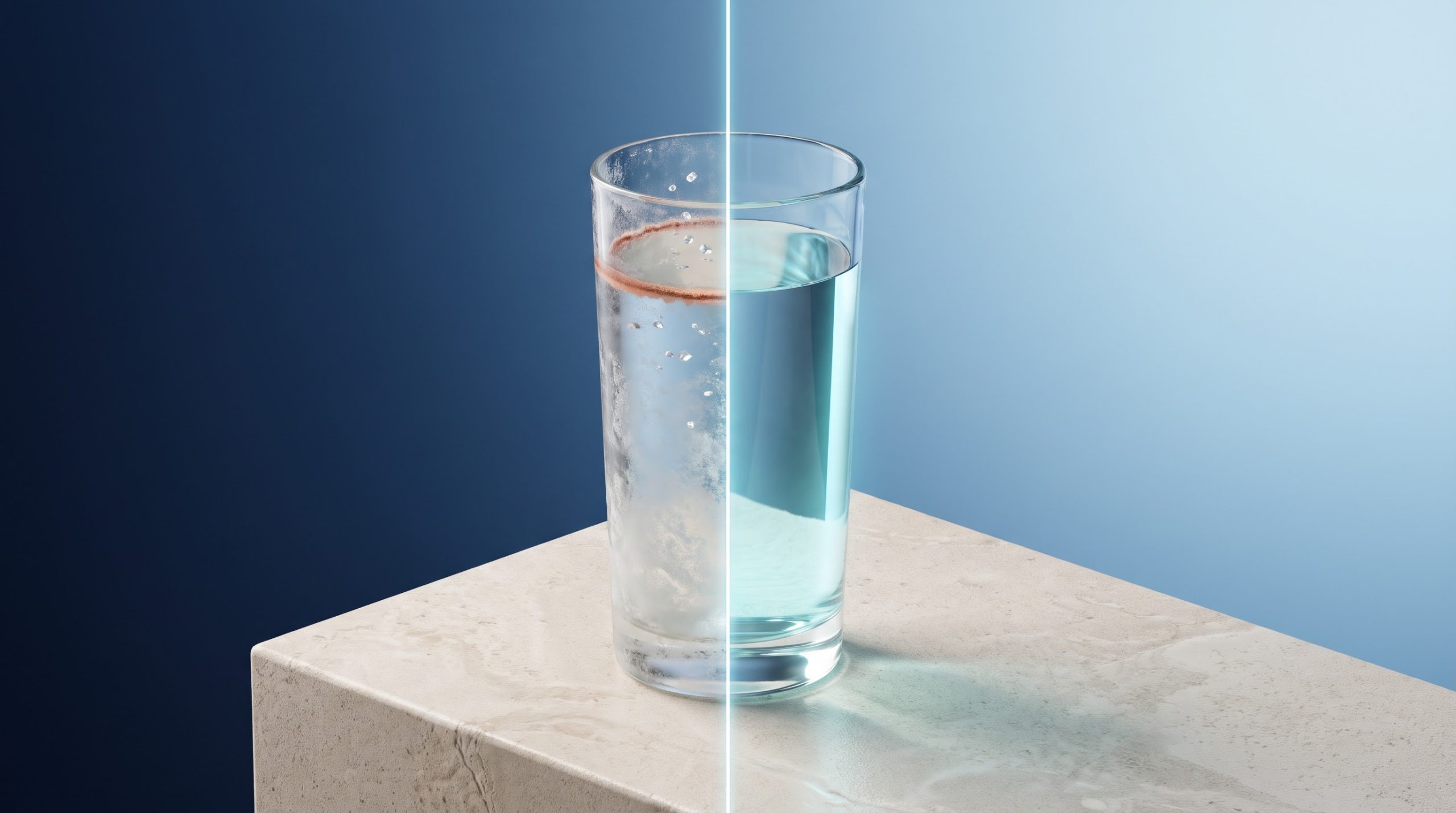
Hard water leaves evidence. White crust on the showerhead, a cloudy film on “clean” glasses, a water heater that rumbles like a kettle. By the time homeowners start shopping, they have usually spent years paying for it in detergent, energy, and replacement fixtures.
What is a whole home water softener system? A whole home water softener system is a point-of-entry treatment unit that removes dissolved calcium and magnesium from every tap in a house. Most use ion exchange resin, swapping hardness minerals for sodium or potassium, then flush the resin with salt brine during a regeneration cycle.
What to settle before you spend a dollar:
- Know your number. Get hardness in grains per gallon (gpg) or mg/L from a lab, not a guess.
- Size by grains, not by tank height. Family size, hardness, and iron content set the capacity.
- Check local law. Some municipalities restrict or ban salt-regenerating units.
- Budget for years 5 to 8. Resin replacement and wastewater charges rarely appear on the sales sheet.
- Plan the plumbing. Bypass loop, air gap, and grounding are where installs go wrong.
The Hard Water Diagnostic: Decoding Your Home’s Mineral Weight
Hardness is a measure of dissolved calcium and magnesium. The USGS hardness classification breaks it down like this:
| Classification | mg/L as CaCO₃ | Grains per gallon |
|---|---|---|
| Soft | 0–60 | 0–3.5 |
| Moderately hard | 61–120 | 3.6–7 |
| Hard | 121–180 | 7.1–10.5 |
| Very hard | >180 | >10.5 |
One grain per gallon equals 17.1 mg/L. Keep that conversion handy, because lab reports and softener spec sheets rarely use the same unit.
Visual indicators you can check this weekend
- Limescale on faucet aerators, kettle elements, and shower glass.
- Soap scum rings in tubs, and soap that refuses to lather.
- Stiff laundry and dingy whites despite adequate detergent.
- Declining flow from scaled showerheads and appliance inlet screens.
- Short water heater life, with sediment sludge and popping noises during heating.
Even a humidifier shows it. Hard-water minerals become airborne white dust, which is why people switch to distilled water for a humidifier. A softener fixes that at the source.
The chlorine problem most buyers never hear about
Municipal water carries a disinfectant residual. The EPA’s maximum residual disinfectant level for chlorine and chloramine is 4 mg/L, and that oxidant reaches your softener 24 hours a day.
Chlorine attacks the cross-linking in standard ion exchange resin beads, so they swell, soften, and shed fragments. In high-residual supplies, resin can lose meaningful capacity within five to eight years. The symptoms are hardness leaking through despite regeneration, brownish resin fines in the drain, and a pressure drop across the tank.
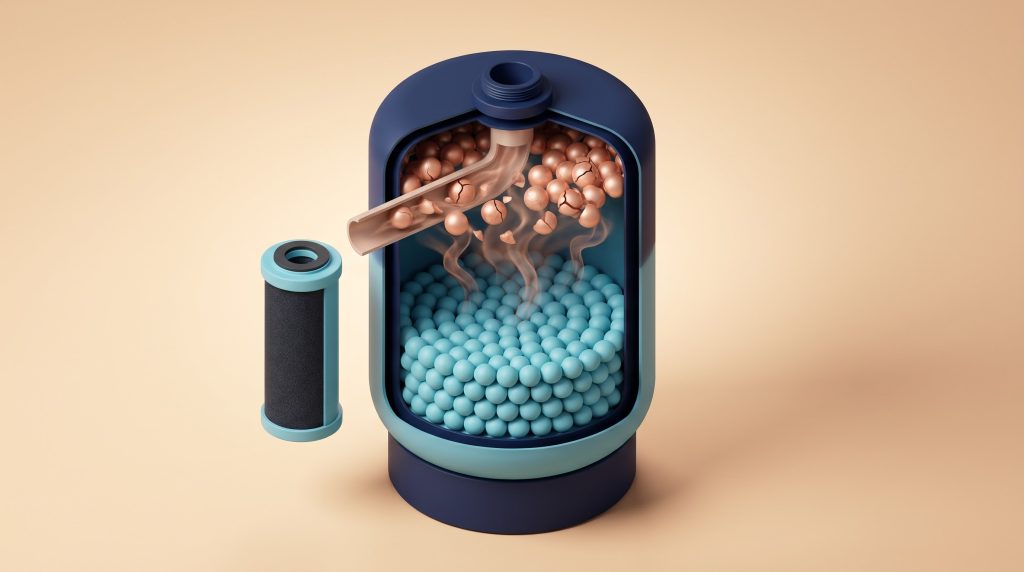
On service calls, I see this pattern most in homes fed by chloraminated systems with no carbon prefilter. A catalytic carbon prefilter ahead of the softener, or higher cross-linked resin (10% instead of the standard 8%), pushes the lifespan back toward its potential. Ask for it by name before you buy.
How to Sample Your Water Before You Buy a Softener
Never size a softener from a city water-quality report alone. Those reports average the distribution system, not your tap. Test at the point where water enters your home.
Step-by-step sampling process
- Request the right bottle. Get the container, preservative, and instructions from the lab first. Don’t improvise with a kitchen jar.
- Pick the sampling point. Use a cold-water tap or hose bib upstream of any existing treatment. If you are already softening, take the sample from a bypassed or untreated line.
- Flush the line. Run the cold tap for 3 to 5 minutes so you capture water from the main, not what has sat in your pipes.
- Remove aerators and screens from the tap if the lab instructs you to.
- Fill without touching. Keep the inside of the bottle and cap clean, and don’t rinse out preservative. Fill to the line.
- Label and chill. Record date, time, and tap location on the bottle. Keep it cool and ship or drop it off inside the stated holding time.
Request a panel that includes total hardness, iron, manganese, pH, alkalinity, TDS, and chlorine. Iron and manganese directly change your capacity calculation. The EPA’s secondary standards flag iron at 0.3 mg/L, manganese at 0.05 mg/L, and TDS at 500 mg/L, and exceeding them can foul resin.
For private wells, the process mirrors this step-by-step well water sampling and lab guide. If you are buying a house with a well, read the well water testing guide for home buyers before closing, since softener sizing can become a negotiation point.
Picking a state-certified laboratory and documenting chain of custody
Use a lab certified by your state under the EPA drinking water laboratory certification program. The EPA’s certification program page explains the process and points you to your state’s certification contact. Confirm that the lab’s certification covers the specific parameters you are ordering.
For results that may influence a real estate deal, a dispute, or a warranty claim, document the chain of custody (CoC). A CoC form typically records:
- Sample ID and collection point
- Collector’s name, date, and time
- Analyses requested
- Each hand-off signature, from you to courier to lab
An undocumented sample is an argument waiting to happen. A documented one is evidence.
Salt-Based Softeners vs. Salt-Free Conditioners: The Absolute Truth
These two product categories are sold side by side and do different jobs.
Ion exchange (salt-based): actual mineral removal
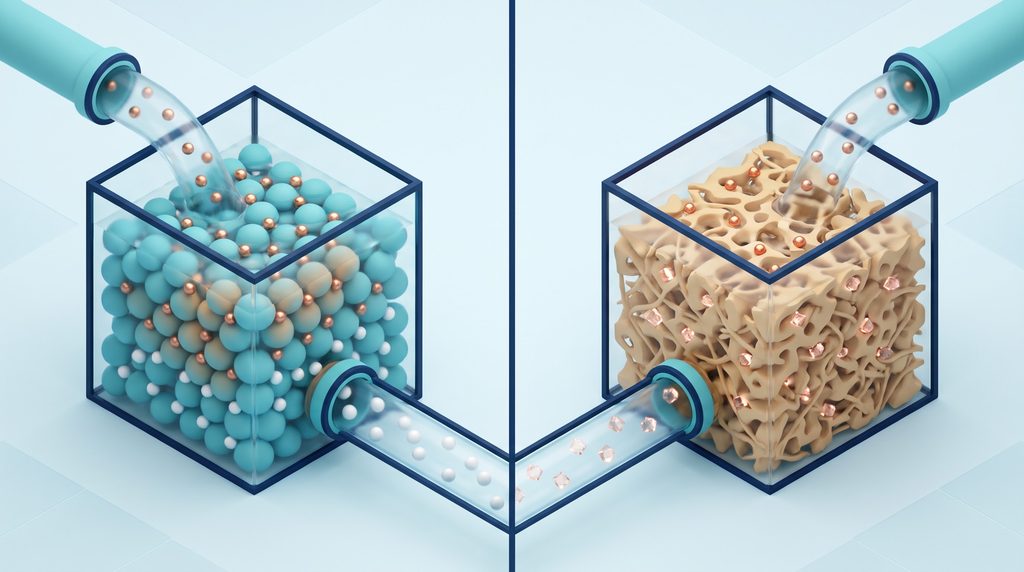
A salt-based softener passes water through a resin bed. Calcium and magnesium cling to the beads, and sodium (or potassium, if you use KCl) releases into the water. When the beads fill, the control valve backwashes and draws brine through the bed to recharge it. The result is measurable soft water, often below 1 gpg, with real benefits for lather, laundry, and scale.
Two trade-offs. First, softened water carries added sodium, about 8 mg/L per gpg of hardness removed. Second, regeneration discharges chloride-rich brine. Households on sodium-restricted diets often leave one kitchen tap on a hard-water bypass or use potassium chloride.
Template Assisted Crystallization (TAC): scale control without removal
A TAC unit, often sold as a “salt-free softener,” doesn’t remove hardness. Water flows over polymer media whose surface contains nucleation sites. Dissolved calcium and magnesium bicarbonate converts into microscopic crystals that stay suspended and don’t adhere to pipes, heaters, or fixtures.
Here’s the part marketing glosses over: the calcium is still in the water. A hardness test strip will read the same before and after. What changes is behavior, because the minerals can no longer form hard scale. Expect:
- Good scale reduction on pipes and heating elements.
- No “slick” soft-water feel, and no major soap and detergent savings.
- Limits on performance with very high hardness, heavy iron, or poor flow conditions.
If a vendor promises TAC will deliver “soft water,” that’s a red flag. Look for third-party scale-reduction testing (for example, DVGW W510 certification) rather than testimonials. Also be clear on what these systems are not. Portable filters like the one in this Sawyer Squeeze filter review are built for microbial removal and do nothing for hardness.
Is Your Water Softener Illegal? Navigating Local Brine Discharge Laws
No federal ban exists. The restrictions are local, and they exist for a reason: salt doesn’t leave the wastewater stream. Municipal treatment plants don’t remove chloride, so it ends up in rivers, recharge basins, and in some regions, reclaimed water used for irrigation. The EPA’s aquatic life criteria set chronic chloride exposure at 230 mg/L, a level that stressed watersheds can reach.
California is the best-known example. State law lets local agencies restrict or prohibit self-regenerating water softeners in areas with chloride problems, and the Santa Clarita Valley used that authority. Chloride limits tied to drought, groundwater recharge, or salt-sensitive agriculture also show up elsewhere in the Southwest and parts of the Midwest. Rules change, so verify with your local utility or sanitation district before you buy. Ask specifically about:
- Outright bans on self-regenerating softeners.
- Efficiency requirements, such as demand-initiated regeneration and maximum gallons or salt per cycle.
- Rebates or buyback programs for removing old timer-based units.
Compliant setups if brine is restricted
- TAC or physical conditioners: no brine discharge, no salt, no electricity for most models.
- Exchange-tank service: a dealer swaps portable resin tanks and regenerates them off-site.
- High-efficiency demand-initiated softeners, where permitted: these meter actual usage and regenerate only when capacity is spent.
- Point-of-use treatment at the fixtures that matter most, such as the water heater feed or the kitchen.
The True Cost of Ownership: Sizing & Financial Realities
Sizing formula
An undersized unit regenerates constantly and wears out early. An oversized one wastes salt and may let resin sit stagnant.
- Daily usage: People in home × 80 gallons. The EPA estimates the average American uses about 82 gallons per day at home.
- Compensated hardness: Hardness (gpg) + 5 gpg for each 1 mg/L of dissolved iron.
- Daily grains: Daily usage × compensated hardness.
- Capacity needed: Daily grains × days between regenerations (7 is a sensible target).
Worked example: A family of four, water at 15 gpg with 1 mg/L iron.
- 4 × 80 = 320 gallons per day
- 15 + 5 = 20 gpg compensated
- 320 × 20 = 6,400 grains per day
- 6,400 × 7 = 44,800 grains
Round up to a 48,000-grain unit. Then check flow. A three-bathroom house with simultaneous showers can demand 10 to 12 gpm at peak, which usually means a 1-inch valve and plumbing.
Hidden multi-year line items
| Cost item | What to expect |
|---|---|
| Salt | Efficient settings remove roughly 3,500–4,500 grains per pound of salt, so a family of four often goes through a bag every few weeks. |
| Regeneration water | High-efficiency units use roughly 25–50 gallons per cycle, while older timer-based valves can use far more. |
| Sewer/wastewater surcharge | Where sewer fees track metered water, regeneration volume is billed too, even though it never leaves through the tap. |
| Electricity | Small, but the control head draws continuously. |
| Resin re-bedding (year 5–8) | Typically a few hundred dollars for media and labor, higher in chlorinated supplies where resin degrades faster. |
| Prefilter cartridges | Sediment and carbon filters need regular changes to protect the resin. |
Ask any dealer for a five-year and ten-year ownership estimate, not just a purchase price.
Flawless Pre-Installation & Plumbing Prerequisites
DIY or professional?
With PEX or CPVC and push-fit fittings, a competent DIYer can finish an install in an afternoon. Copper sweating, relocated main lines, permit requirements, and well-system tie-ins are where a licensed plumber earns their fee. Check whether your jurisdiction requires a permit. Professional installation commonly runs several hundred dollars, and more if the existing plumbing needs rework.
The three items manuals skip
1. Bypass loop. Install a three-valve bypass (inlet, outlet, and a cross-connection) or a manufacturer’s bypass valve. Without it, any service, resin change, or fault means shutting off water to the entire house. A bypass also lets you route hard water to outdoor spigots. Plumb the softener after the pressure tank on a well, and ahead of the water heater, with plenty of pipe run between them if the manufacturer calls for it.
2. Drain line air gap. The drain hose must never be submerged or sealed into a standpipe, because a blocked sewer could pull wastewater back into the softener. Maintain a physical air gap, commonly at least 1 inch under the plumbing code and often 1.5 inches per manufacturer instruction. Follow local code and the unit’s manual. Keep the drain run short, supported, and not excessively elevated.
3. Electrical grounding and surge protection. The control valve runs on a low-voltage transformer, but it needs a grounded outlet. Use a dedicated outlet and add a surge protector, since a lightning strike or brownout can scramble the programming. When you cut into metal supply lines, install a ground jumper across the softener so electrical continuity of the home’s bonding path is preserved. Many people miss this, and it matters for safety.
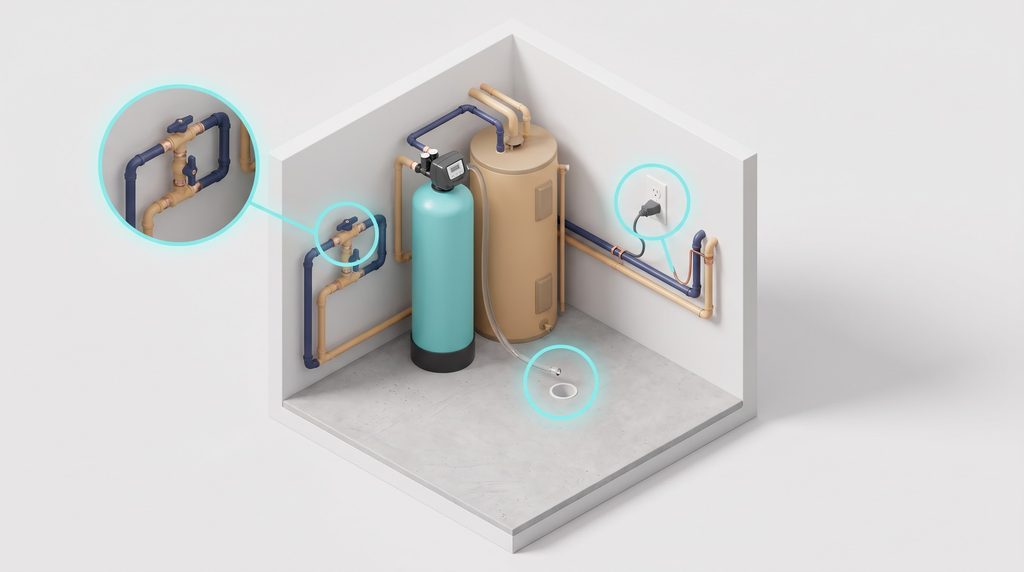
Check inlet pressure (generally 20 to 125 psi is the working range) and install a pressure regulator if you exceed it.
Frequently Asked Questions
How big a water softener do I need for a family of four?
- Start with 4 people × 80 gallons per day.
- Multiply by hardness in gpg, adding 5 gpg per mg/L of iron.
- Multiply by 7 days.
- A typical result is a 32,000–48,000 grain unit.
Does a salt-free water softener actually remove hardness?
- No. It conditions the minerals so they don’t form scale.
- Calcium and magnesium remain in the water.
- Expect scale reduction, not a soft-water feel.
Can I install a whole home water softener myself?
- Yes, with PEX or push-fit connections and basic plumbing skills.
- Hire a plumber for copper, permits, or well systems.
- Install the bypass, air gap, and grounding either way.
Are water softeners banned anywhere?
- Some local jurisdictions restrict or prohibit salt-regenerating units.
- California communities and other chloride-limited regions are examples.
- Call your utility or sanitation district before buying.
How long does softener resin last?
- Often 10+ years in low-chlorine water.
- Closer to 5–8 years where chlorine or chloramine is high.
- A carbon prefilter extends resin life.
Test First, Then Buy
Every month you run hard water through your plumbing, scale thickens inside pipes and appliances you can’t see. A softener bought on a guess can be the wrong size, the wrong technology, or illegal in your district. A certified water analysis costs a small fraction of any of those mistakes.
Order a lab-grade water analysis today. Get your hardness, iron, and chlorine numbers, then size the right whole home water softener system for your household and your local rules.






[…] hardness, iron, or manganese runs high, you’re looking at treatment, and sizing matters. Our whole-home water softener sizing, costs, and legal limits guide walks through the numbers. Hard well water also leaves mineral dust when used in appliances, which […]
[…] A filter removes contaminants. A salt-based softener swaps calcium and magnesium for sodium through ion exchange, adding about 8 mg/L of sodium per grain of hardness removed. A template-assisted crystallization (TAC) salt-free conditioner doesn’t remove hardness at all. It changes how scale forms so it clings less. Sizing, costs, and legal limits on brine discharge are covered in this whole-home softener sizing and installation guide. […]
[…] hardness below about 7 grains per gallon. If your well is hard, softening comes before UV. Our whole-home water softener sizing, costs, and installation guide covers that half of the […]