

By the Water Velor editorial team · Last updated November 13, 2026
Picture the lab report sitting on your kitchen counter. Nitrate at 14 mg/L. Coliform bacteria present. A sales rep already quoting a $4,000 whole-house unit. Which of those problems does that unit actually solve? Possibly none of them.
That gap between the problem and the product is where most buyers lose money. This guide closes it. You’ll match your water to a technology, size the system so showers don’t turn to a trickle, and price the next five years instead of just the sticker.
Quick answer: A household water purification system is a point-of-entry or point-of-use treatment setup that removes germs, metals, and chemicals from tap or well water. Choose it by testing your water, matching each contaminant to a certified technology, and sizing flow to your home’s peak demand before you buy.
- Test: Read your utility report or run a state-certified lab panel.
- Match: Pair each contaminant with the technology that actually removes it.
- Size: Match gallons per minute (GPM) to peak demand, not average use.
- Protect: Put a sediment pre-filter ahead of anything sensitive, such as UV.
- Maintain: Replace cartridges on schedule and sanitize housings.
How to Choose the Right Household Water Purification System
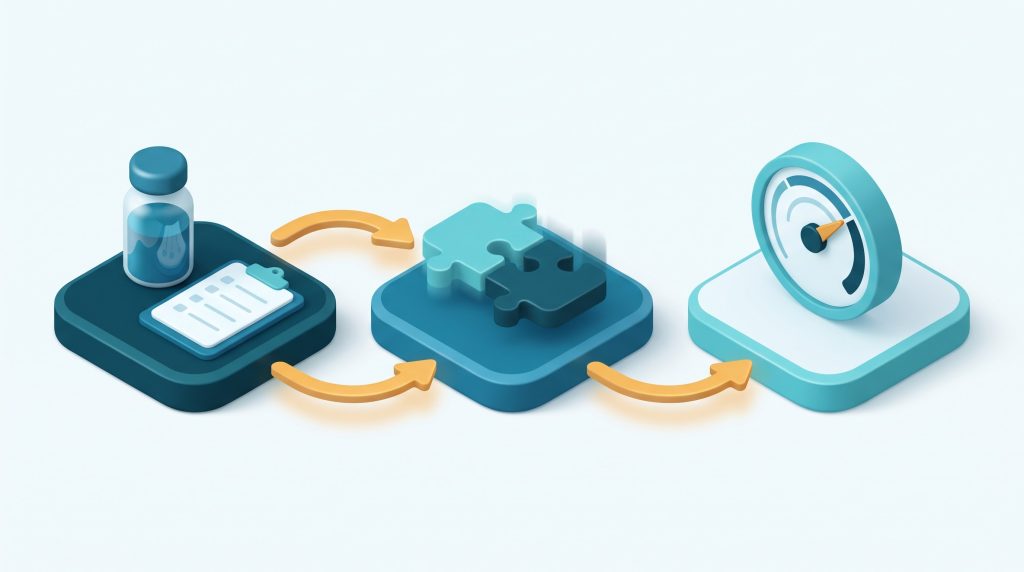
The fastest way out of buyer paralysis is a three-step sequence: Test, Match, Size. Skip the first step and the other two are guesses.
Step 1: Test Your Water
City water and well water start from different places.
- City or town water: Your utility must publish an annual Consumer Confidence Report (CCR). The EPA’s CCR page explains what the report contains and where to find yours. Look at lead, disinfectant type (chlorine or chloramine), and any violations.
- Private wells: Nobody tests the water for you. In a USGS national study of about 2,100 domestic wells, 23 percent contained at least one contaminant above a human-health benchmark. Private wells serve roughly 15 percent of Americans, and the Safe Drinking Water Act doesn’t cover them.
For a well, buy a lab test, not a hardware-store strip. A full walkthrough lives in our step-by-step guide to sampling, labs, and results for well water.
Choosing a State-Certified Lab and Documenting Chain of Custody
A purchase this large deserves defensible numbers. Use a lab certified by your state for drinking water analysis. The EPA keeps a directory of drinking water laboratory certification programs and contacts for every state.
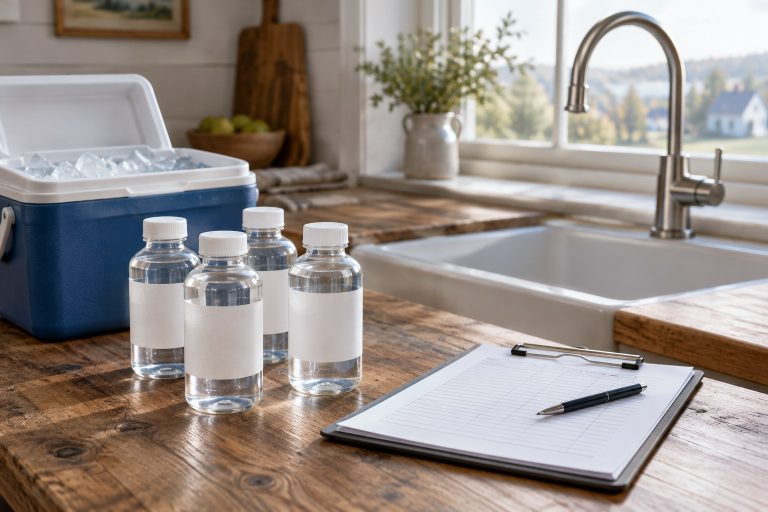
Before you sample, ask the lab three things: which panel fits a private well in your region, the maximum hold time, and whether it supplies a chain of custody (CoC) form.
The sampling routine that keeps a result valid:
- Use the lab’s sterile bottles. Never rinse them. Many contain a preservative.
- Pick a cold tap before any treatment device. Remove the aerator and sanitize the spout.
- Run the water long enough to pull fresh supply, then slow it to a pencil-thin stream.
- Don’t touch the inside of the cap or neck.
- Label the bottle with name, location, date, and the exact collection time.
- Chill it right away, never freeze it, and deliver it inside the hold time. Coliform samples often have a hold time around 30 hours.
The CoC form is the lab’s record of who collected the sample, when, and how it was handled. Your sample ID and collection time must match the bottle exactly. Mismatched times are a common reason for rejection. Photograph the completed form before you seal the cooler.
Buying a home with a well? Lenders and buyers want certified numbers, and the testing window is short. See our well water testing guide for home buyers, or, for Rhode Island sales, the 10-day home sale checklist for buyers.
Step 2: Match the Contaminant to the Technology
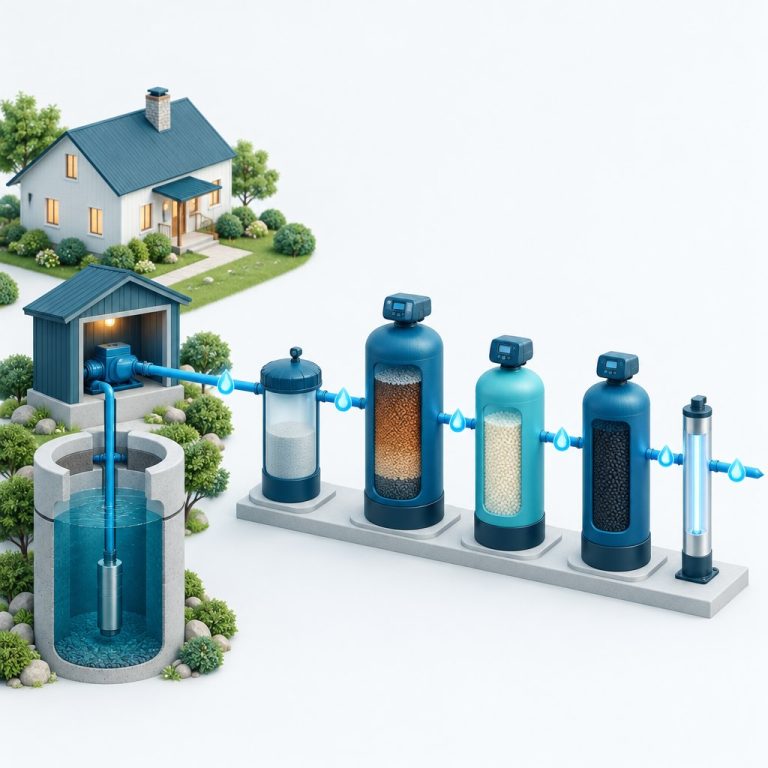
No single device handles everything. Bacteria need disinfection or a microbiological-rated filter. Lead, arsenic, and nitrate need specific media or membranes. Chlorine taste needs carbon. Hold your report next to the table in the “Contaminant-to-Filter Matchmaker” section below.
Step 3: Size the System
Undersized systems are the quiet failure. Flow falls, shower pressure drops, and cartridges clog early.
The GPM rule of thumb for whole-home (point-of-entry) systems:
| Home size | Typical peak flow to plan for |
|---|---|
| 1 to 2 bathrooms | 7 to 10 GPM |
| 3 or more bathrooms | 12 to 15+ GPM |
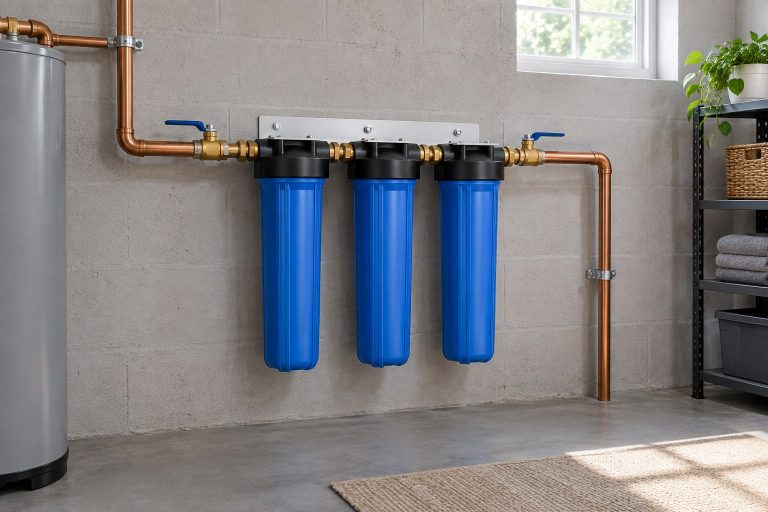
Treat those numbers as a starting point, then check them against your own peak moment: two showers, a dishwasher, and a washing machine running together. EPA WaterSense caps showerheads at 2.0 GPM and bathroom faucets at 1.5 GPM, and washers and outdoor spigots can pull more. Add up what could run at once, then pick a system rated at or above that flow at your actual line pressure. Our whole-house water filtration buyer’s guide walks through sizing and installation in detail.
Point-of-use systems (RO, under-sink carbon) serve one tap, so their rated GPM matters far less.
6 Main Types of Home Water Purification Systems Compared
The search results for this topic split in two: corporate product catalogs on one side, emergency-sanitation research on the other. Buyers need both on one page.
First, a translation. Researchers describe germ removal in “log reduction.” Each log is a factor of ten.
| Log reduction | Plain English |
|---|---|
| 1 log | 90% removed |
| 2 log | 99% removed |
| 3 log | 99.9% removed |
| 4 log | 99.99% removed |
| 5 log | 99.999% removed |
The WHO International Scheme for evaluating household water treatment ranks products in star tiers. A three-star (“highly protective”) product must achieve at least 4-log reduction of bacteria (99.99%), 5-log for viruses (99.999%), and 4-log for protozoa (99.99%). Two-star requires 2-log, 3-log, and 2-log respectively. A one-star listing covers only some pathogen classes.
| System | Best for | Removes | Does not reliably remove | Maintenance |
|---|---|---|---|---|
| Reverse osmosis (RO) | Drinking and cooking tap | Dissolved solids, lead, arsenic, nitrate, fluoride, many chemicals | Some dissolved gases; wastes water | Pre-filters 6 to 12 months, membrane 2 to 3 years (typical) |
| Whole-house catalytic carbon | Chlorine, chloramines, taste, odor, some chemicals | Chlorine and chloramine, many organics | Bacteria, nitrate, most metals | Media or cartridge on schedule |
| Under-sink carbon block | Lead, cysts, VOCs, taste at one tap | Lead, cysts, VOCs (if certified) | Nitrate, fluoride, most dissolved solids | Cartridge every 6 to 12 months (typical) |
| UV disinfection | Bacteria and viruses in clear well water | Bacteria, viruses, protozoa (at proper dose) | All chemicals, metals, sediment | Lamp yearly, sleeve cleaning |
| Ceramic gravity filters | Off-grid and backup | Bacteria, protozoa, sediment | Viruses (usually), chemicals | Scrub or replace element |
| Emergency multi-barrier | Power outage or disaster | Pathogens when layered | Chemicals, unless carbon is added | Supplies and technique |
A note on certification tiers: several evaluated ceramic, diatomaceous-earth, and solar units earned only the WHO one-star level. Buy against the tier you need, not the brand’s slogan.
Reverse Osmosis vs. Whole-House Carbon vs. UV Disinfection
This is the real buying dilemma, and it comes down to point-of-entry (treats every tap) versus point-of-use (treats the drinking tap).
Reverse Osmosis: Point-of-Use Precision
RO pushes water through a membrane that rejects most dissolved material. It’s the strongest single option for lead, arsenic, nitrate, and fluoride at the kitchen tap. Treat three costs as part of the purchase:
- Wastewater. Traditional under-sink units discharge roughly 3 to 4 gallons for each gallon of purified water. Modern tankless designs advertise ratios near 1:1, though real results shift with line pressure, water temperature, and dissolved solids.
- Flow. Tank-based units make water slowly, then store it.
- Minerals. RO strips most calcium and magnesium. More on that in the FAQ.
Whole-House Catalytic Carbon: Chloramine Control
Many city systems disinfect with chloramine, which is more stable than free chlorine. Standard carbon struggles with it. Catalytic carbon is built to break it down. If your CCR lists chloramine and you’ve noticed dry skin or odor in showers, a whole-house catalytic carbon tank treats every tap. It won’t touch bacteria, nitrate, or most metals.
UV Disinfection: Germs Only, and Only in Clear Water
UV lamps inactivate bacteria, viruses, and protozoa by damaging their genetic material. They don’t remove a single chemical, metal, or particle. Buy by certification: NSF/ANSI 55 Class A units deliver a minimum dose of 40 mJ/cm². Class B units deliver 16 mJ/cm² and are meant only for supplemental treatment of water that’s already safe.
Safety warning: the turbidity trap. UV light can’t kill what it can’t reach. Cloudy water carries particles that shield microbes from the lamp. Many UV makers require influent turbidity below 1 NTU, and guidance on UV disinfection recommends pre-filtering once turbidity reaches 5 NTU. Always install a 5-micron sediment filter ahead of the lamp. Iron, manganese, tannins, and high hardness also foul the quartz sleeve, so test for them first.
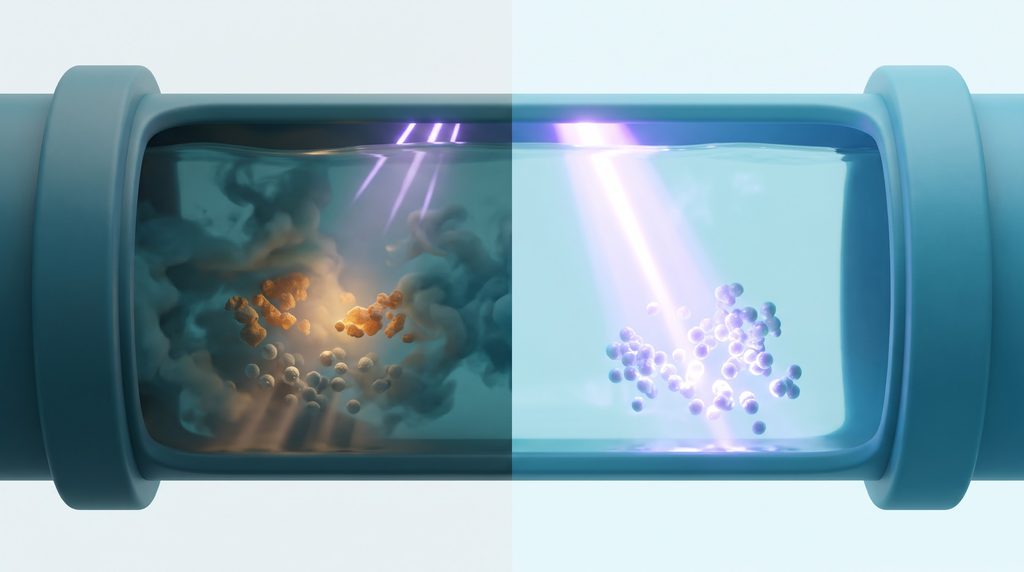
UV makers also tend to specify hardness below about 7 grains per gallon. If your well is hard, softening comes before UV. Our whole-home water softener sizing, costs, and installation guide covers that half of the system.
Contaminant-to-Filter Matchmaker (NSF/ANSI Standards)
“Removes 99% of contaminants” means nothing without a standard. Third-party certification is per-contaminant, so always confirm the exact claim on the product’s public listing.
| Standard | What it covers |
|---|---|
| NSF/ANSI 42 | Aesthetic effects: chlorine, taste, odor |
| NSF/ANSI 53 | Health effects: lead, cysts, VOCs, and, on listed models, PFOA/PFOS |
| NSF/ANSI 55 | UV microbiological treatment (Class A and B) |
| NSF/ANSI 58 | Reverse osmosis: dissolved solids, arsenic, fluoride, nitrate and more |
| NSF/ANSI 401 | Emerging compounds: selected pharmaceuticals, pesticides, herbicides |
| NSF P473 | PFOA and PFOS protocol, now folded into NSF/ANSI 53 listings |
| Contaminant | What to look for |
|---|---|
| Lead | NSF/ANSI 53 or 58 listing for lead reduction |
| PFAS (PFOA and PFOS) | NSF/ANSI 53 or 58 listing that names PFOA/PFOS (P473 testing) |
| Arsenic | NSF/ANSI 58 or 53; check the arsenic form (As V vs As III) |
| Fluoride | NSF/ANSI 58 |
| Microplastics | No dominant certification claim exists; RO and very fine carbon blocks exclude particles, so check the listing |
| Chlorine | NSF/ANSI 42 |
| Chloramines | NSF/ANSI 42 listing for chloramine reduction, usually catalytic carbon |
| E. coli and other bacteria | NSF/ANSI 55 Class A UV or a certified microbiological purifier |
| Pharmaceuticals | NSF/ANSI 401 |
Why the PFAS row matters. Older WHO, CDC, and pathogen-focused research barely mention PFAS, microplastics, or pharmaceuticals. They’re modern chemical threats, and carbon, ion exchange, and RO are the tools. The EPA has said it will keep its 4 parts per trillion limits for PFOA and PFOS, though it has proposed extending compliance dates to 2031 and changing limits for other PFAS compounds. Those proposals aren’t final, so check the EPA’s PFAS page before you act on a borderline result.
A certified-lab PFAS panel costs several hundred dollars, and it’s worth running only if your location raises the risk: near an airport, military base, fire-training site, or industrial plant.
Emergency and Off-Grid Household Water Purification
This is the layer most buying guides skip, and it matters when the grid, the pump, or the utility fails.
- Boiling. The CDC’s guidance is a rolling boil for 1 minute (3 minutes above 6,500 feet), then cool and store covered. See the CDC’s guidance on water treatment when camping or traveling. It kills pathogens but removes no chemicals.
- Solar disinfection (SODIS). Fill clear 2-liter PET bottles with water under 30 NTU, then expose them to direct sun for 6 hours on sunny days or 48 hours when it’s cloudy. A review of SODIS parameters confirms those figures. It fails in continuous rain and does nothing for arsenic, fluoride, or agricultural chemicals.
- Gravity ceramic filters. Good for bacteria and protozoa, weaker on viruses, and the WHO’s product listings show most evaluated ceramic units at the one-star tier. Pair with chemical disinfection.
- Portable hollow-fiber membranes. Squeeze and inline filters are compact and fast. They remove bacteria and protozoa but not viruses or dissolved chemicals. Our Sawyer Squeeze water filter review compares one popular model against alternatives.
What about homemade sand-and-charcoal buckets? They can clear cloudiness, which helps the next step work. They aren’t tested products, so no WHO tier applies. Treat the result as pre-filtered, not safe, and finish with boiling or chemical disinfection.
Store treated water in clean, covered containers. Re-contamination during storage undoes good treatment.
True 5-Year Cost of Ownership and Maintenance Schedule
The sticker price is the smallest number. Total cost of ownership is:
Hardware + installation + (annual consumables × 5) + water and energy costs
The ranges below are planning estimates based on typical U.S. retail pricing. Quotes in your area will differ, so treat them as a starting frame.
| System | Hardware | Installation | Annual consumables |
|---|---|---|---|
| Under-sink carbon block | $100 to $300 | DIY or $100 to $250 | $50 to $150 |
| Under-sink RO | $200 to $700 | $150 to $400 | $100 to $250 |
| Whole-house sediment and carbon | $800 to $2,500 | $500 to $1,500 | $100 to $600 |
| UV disinfection | $400 to $1,000 | $150 to $500 | $100 to $200 (lamp) plus pre-filters |
| Ceramic gravity | $50 to $300 | None | Element replacement |
Illustrative cost-per-gallon example (RO): $400 hardware + $250 installation + ($150 × 5 years) = $1,400. A household drinking and cooking with 3 gallons a day uses about 5,475 gallons in five years. That’s roughly 26 cents per gallon, before counting wastewater. Compare that figure to your own bottled-water spending.
The Maintenance Schedule
Typical intervals (always follow your manufacturer):
- Sediment pre-filter: every 3 to 6 months, or when pressure drops
- Carbon block or media: every 6 to 12 months
- RO membrane: every 2 to 3 years
- UV lamp: every 12 months, even if it still glows
The Biofilm and Re-Contamination Protocol
Neglected cartridges don’t just stop working. They can make water worse.
Activated carbon is a food source and a surface for bacteria. A study of 24 rural groundwater supplies found bacterial counts rose after overnight stagnation in carbon-treated water, then fell after the device was flushed for two minutes. A separate laboratory study found that carbon block point-of-use filters can raise bacterial counts in filtered water, with effluent counts plateauing up to 100 times higher than influent counts as the filter neared its rated volume.
The fix is procedural:
- Flush after stagnation. Run the tap for about two minutes after the system sits overnight or longer.
- Change on schedule. Don’t stretch cartridges past their rated life.
- Sanitize the housing at every swap. Wash your hands, shut off the supply, release pressure, and remove the cartridge. Clean the housing and O-ring, then sanitize with the manufacturer’s recommended solution and rinse thoroughly.
- Flush the new cartridge as the instructions specify before drinking from it.
- Retest. A yearly certified-lab coliform test confirms the whole system, not just the label.
Frequently Asked Questions
Does reverse osmosis remove healthy minerals?
Yes, mostly. RO membranes reject most dissolved calcium and magnesium along with contaminants, and NSF/ANSI 58 systems must cut total dissolved solids by at least 75%. Food supplies most minerals for healthy adults. If you dislike the flat taste, add a remineralization cartridge. See the WHO report on nutrients in drinking water.
Can renters install a household water purifier?
Yes, with limits. Countertop RO units, pitchers, and faucet-mounted filters need no plumbing changes. Under-sink systems usually require drilling or a drain saddle, so get your landlord’s written approval first. Keep the original fittings and restore them when you move out.
How do I test if my water purifier is still working?
Compare TDS meter readings before and after an RO membrane. Falling rejection signals failure. For UV, confirm the lamp is on and replace it yearly. For carbon, watch for chlorine taste returning. Confirm any germ-removal claim with a certified-lab coliform test.
Do I need both a water softener and a water purifier?
Often, on hard well water. A softener removes the calcium and magnesium that scale pipes and coat UV sleeves. A purifier handles contaminants and germs. Because UV makers want hardness under about 7 grains per gallon, softening comes before disinfection.
What is the best household water purification system for well water?
Test first. Most wells need a sediment pre-filter, then UV for bacteria, plus carbon or RO based on lab results for metals, nitrate, or chemicals. Pick units certified to NSF/ANSI 55 for UV and 53 or 58 for the contaminants you actually have.
Is a water purifier different from a water filter?
Yes. A filter removes particles or specific chemicals. A purifier is held to a higher microbiological standard and must address bacteria, viruses, and protozoa. Check the certification and the WHO or NSF/ANSI claim, since marketing terms aren’t regulated the same way.
How often should I replace purifier filters?
Follow the manufacturer’s schedule. Typical intervals are sediment filters every 3 to 6 months, carbon every 6 to 12 months, RO membranes every 2 to 3 years, and UV lamps yearly. Replace sooner if flow drops or taste changes. Expired carbon can grow bacteria.
Test This Week, Then Buy Once
The wrong system costs twice: the purchase, then the problem it never fixed. The right one starts with a number from a state-certified lab. Pull your CCR if you’re on city water, or book a certified-lab panel if you’re on a well, and match every flagged contaminant to a certified technology before anyone quotes you hardware.
If you’re on a private well, your next step is simple: schedule a lab test this week, using the sampling steps in our well water testing guide. For appliance-specific water questions, such as steam or humidifier use, see our guide to distilled water for humidifiers. Order the analysis, then choose the system.
This article is for general education and isn’t a substitute for advice from your local health department or a licensed water treatment professional. Standards and limits change, so confirm current values with the EPA and your state.



[…] Water Filters and Whole House systems once you know your contaminants. Our household water purification guide and whole-house filtration buyer’s guide walk through sizing. Our Buying Guides and Reviews […]